August 3, 2026

In This Article
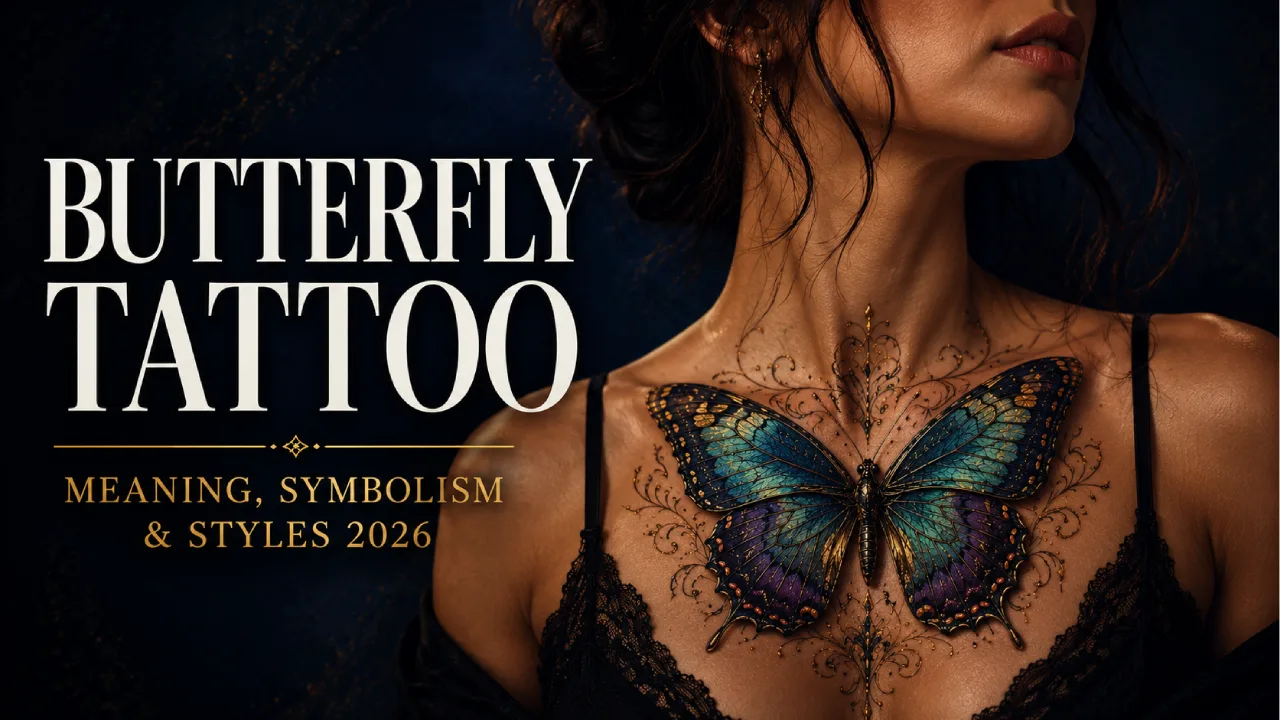
The butterfly is the single most searched tattoo design on the planet — averaging over 428,000 global searches per month. But what does it actually mean? The answer is layered, personal, and surprisingly deep. This guide covers every dimension of butterfly tattoo meaning: the core symbolism, what each colour communicates, what placement says about your story, which styles suit which intentions, and how to care for your new piece through every stage of healing.
A butterfly tattoo carries meaning at multiple levels simultaneously. At the broadest level, it is a symbol of radical personal change — the kind that does not happen gradually but requires a complete breakdown before something new can emerge. At a more personal level, it means exactly what the person wearing it needs it to mean: the end of an addiction, the survival of a painful relationship, a fresh start after loss, or simply the joy of becoming more fully themselves.
What makes the butterfly so enduring as a tattoo symbol is the specificity of its metaphor. The caterpillar does not simply grow wings. Inside the chrysalis, it literally dissolves — its body breaks down into a liquid cellular soup before the new form assembles itself from that raw material. This is not a gentle evolution. It is a complete deconstruction followed by a complete reconstruction. For anyone who has gone through the kind of change that required losing who they were before they could become who they are, that specific biological reality resonates on a visceral level.
That is why people get butterfly tattoos. Not because it is a pretty image — though it often is — but because it captures something that is otherwise difficult to say in words.
Transformation is the primary and most universal meaning of the butterfly tattoo. The metamorphosis from caterpillar to butterfly is one of the most dramatic physical transformations in the natural world — and its emotional parallel for human experience is immediately obvious.
People who choose a butterfly tattoo for this meaning are often marking a specific turning point: getting sober, ending a destructive relationship, recovering from illness, finishing a period of grief, or making a life decision that changed everything. The tattoo becomes a permanent record of the person they were before, and a daily reminder of the person who emerged from that experience.
A butterfly tattoo marking transformation is almost always tied to a specific event or period. The chrysalis phase — the dark, confined, vulnerable stage before emergence — is as important to the symbol as the butterfly itself. Many people who choose this meaning say the tattoo honours the struggle as much as the outcome.
Resilience is transformation’s quieter companion. The chrysalis phase is not passive — it requires the caterpillar to survive a period of complete dissolution while fully exposed to threat, with no defences, trusting entirely in an internal process it cannot control or speed up.
For many people, that is exactly what their “chrysalis” periods have felt like. A butterfly tattoo chosen for this meaning honours the waiting, the enduring, and the trusting — the unglamorous middle of a difficult journey rather than the dramatic ending. It is a tribute to the kind of strength that is quiet and consistent rather than visible and celebrated.
Freedom is the final act of the butterfly’s story. After the dissolution, after the rebuilding, the butterfly’s first act is flight. That moment — breaking out of the chrysalis and rising into open air — is one of the most powerful images of liberation in the natural world.
A butterfly tattoo chosen for freedom often marks an escape: from a controlling relationship, from a life that felt too small, from a career that felt like a cage, from a version of themselves they had outgrown. The butterfly in flight says: I broke out. I left. I am moving now, on my own terms, in my own direction.
Love and remembrance are the fourth dimension of butterfly symbolism, and one that many people outside tattoo culture do not immediately associate with this design. In numerous traditions — Japanese, Native American, Celtic, and others — butterflies are understood as the souls of loved ones who have passed, returning briefly to offer comfort or guidance.
A butterfly landing on you has been interpreted across many cultures as a message from the spirit world. For people who have lost someone significant, a butterfly tattoo can be a memorial — a permanent acknowledgment of the bond that continues even after death, and a daily reminder of presence rather than absence.
The butterfly carries distinct and sometimes contradictory meanings across different cultural traditions, and understanding those layers can give a design genuine depth beyond the universal Western symbolism of transformation.
| Culture | Primary Meaning | Notes |
| Ancient Greek | The soul (psyche) | The Greek word “psyche” means both soul and butterfly — the goddess Psyche was depicted with butterfly wings |
| Japanese | Marital bliss, young womanhood, the soul | Two butterflies together represent marital joy; a single butterfly can represent womanhood or a departed soul |
| Aztec | Warriors’ souls, fire, honour | Butterflies represented fallen warriors’ souls; connected to the goddess Xochiquetzal and the concept of sacred sacrifice |
| Celtic | Immortality, rebirth, the soul’s journey | Celtic tradition linked butterflies to the soul leaving the body; also associated with transformation through death into new life |
| Native American | Change, hope, spirit communication | Butterflies were messengers between the living and the spirit world; used in storytelling, ceremony, and traditional art |
| Chinese | Love, longevity, joy | Two butterflies together represent lasting love; the butterfly also appears in art and poetry as a symbol of joy and long life |
| Christian | Resurrection and new life | The butterfly’s lifecycle mirrors resurrection — caterpillar (mortal life), chrysalis (tomb), butterfly (risen, transformed) |
Color is one of the most powerful ways to personalise a butterfly tattoo’s meaning. The same design in different colours tells completely different stories — and choosing the right palette is as important as choosing the right placement or style.
A black butterfly is one of the most powerful and complex choices in the spectrum. It can represent the overcoming of a genuinely dark period — depression, loss, addiction, trauma — and the emergence that followed. It can also serve as a memorial for someone who has died. In many folk traditions, a black butterfly appearing in or near a home is an omen of significant change. As a tattoo, it carries gravity, elegance, and the quiet power of someone who has been through something real.
Blue butterflies are among the rarest in nature — species like the Blue Morpho and the Karner Blue are famous for their extraordinary wing colour. In tattoo symbolism, blue represents calm, spirituality, hope, and freedom. A blue butterfly tattoo is often chosen by people who have come through something difficult and found peace on the other side — not just change, but the specific serenity that follows change. It is also associated with good luck and wishes coming true across several traditions.
The Monarch butterfly is the most recognisable butterfly in the world, and its orange and black wings have become iconic in tattoo culture. The Monarch is known for its extraordinary annual migration — thousands of miles across North America — making it a symbol of endurance, determination, and purpose-driven journey. An orange butterfly tattoo often represents a long, deliberate transformation rather than a sudden one: the kind of change that requires sustained effort over time.
Yellow butterflies carry associations with joy, optimism, and new beginnings. In some folk traditions, seeing a yellow butterfly at the start of summer predicts a season of happiness. As a tattoo, yellow is often chosen by people marking a genuinely happy transition — not overcoming something dark, but celebrating something bright. It is a joyful symbol without the heaviness of black or the complexity of blue.
Red is the colour of passion, intensity, and raw emotion. A red butterfly tattoo speaks to transformation driven by deep feeling — love, anger, grief, or desire. It is a less common choice than blue or black but a powerful one, often chosen by people whose personal changes were driven by intense emotional experiences rather than gradual reflection. In some traditions, a red butterfly is considered a warning sign — making it a particularly interesting choice for people who have faced real danger and emerged from it.
Watercolour butterfly tattoos use flowing, blended colour washes without strong outlines — mimicking the look of watercolour painting on skin. The style itself communicates something: fluidity, creativity, and the embrace of complexity. A watercolour butterfly suits people whose transformation has been multidimensional — emotional, creative, spiritual, and personal all at once. It is also a strong choice for people who want a vivid, artistic piece rather than a symbolic statement alone.
A black and grey butterfly strips colour away and focuses entirely on form, texture, and tonal depth. This is often chosen for memorial pieces or for people whose transformation was deeply serious — grief, illness, major loss. The absence of colour adds gravity and timelessness. A black and grey butterfly rendered realistically can capture the delicate powdery texture of actual wings with extraordinary detail, making it one of the most technically impressive versions of this design.
Where you place a butterfly tattoo shapes its meaning as much as the design itself. Placement communicates visibility, intimacy, and the relationship between the symbol and your body.
A butterfly on the wrist or hand is a constant companion. You see it with every movement of your hands — eating, writing, working, gesturing. It is the most intimate placement in terms of daily visibility to yourself, and one of the most visible placements to others. People choose the wrist for transformation or resilience symbols they want to keep close as a daily reminder. Healing requires careful attention here as hands are high-movement areas — see our healing stages guide for what to expect.
The forearm is one of the most classic tattoo placements for a reason. It is visible when you choose to show it and coverable when context requires. A butterfly on the forearm is a confident, public declaration — “I went through this, I changed, and I am not hiding it.” The inner forearm adds a more personal dimension — it is visible to you when you turn your arm over, a private reminder rather than a public statement.
Placing a butterfly between or over the shoulder blades — where wings would naturally emerge — is one of the most symbolically resonant placement choices available. It connects the image to the body in a literal way. A butterfly on the back also represents something that supports you without you seeing it — the change that has become foundational to who you are, even if others only see it when you choose to reveal it.
The thigh is one of the most popular placements for larger butterfly designs because the flat, wide canvas accommodates detailed work beautifully. It is also an intimate placement — generally hidden in daily life and revealed by choice. Many people choose the thigh for butterfly tattoos that represent personal transformation they have not fully shared publicly: healing from something private, marking a change that is theirs alone.
An ankle or foot butterfly connects transformation to movement — to the literal act of walking forward. It is a grounding placement, tying new beginnings to every step taken. People who choose the ankle or foot often describe their butterfly as marking a journey that is ongoing rather than complete: a reminder with every step that they are continuing to move in a new direction.
A butterfly on the chest or sternum sits close to the heart — and that proximity is intentional. This placement is chosen for the most deeply personal meanings: love, grief, memorial, or a transformation that was fundamentally emotional rather than circumstantial. It is not publicly visible in daily life, which is exactly the point. It belongs to the wearer alone.
A small butterfly on the neck or behind the ear is one of the most delicate and intimate placements available. These are typically small, fine-line pieces — personal reminders rather than public statements. They are also among the most sensitive placements to tattoo and require particularly careful aftercare during healing. Our guide on what to use for tattoo aftercare covers the right products for sensitive placements.
The artistic style you choose for a butterfly tattoo shapes its emotional register as much as the design itself. The same butterfly symbol executed in different styles communicates very different things.
| Style | Key Characteristics | Best For |
| American Traditional | Bold outlines, limited vibrant colours, flat shading | Timeless strength, resilience, confident transformation |
| Japanese (Irezumi) | Dynamic flow, natural elements, rich colour, narrative depth | The soul’s journey, spiritual connection, harmony |
| Black and Grey Realism | Lifelike detail, soft shading, tonal depth only | Memorial pieces, profound personal change, introspective emotion |
| Fine Line / Minimalist | Thin precise lines, minimal shading, single needle work | Quiet personal transformation, subtlety, modern elegance |
| Watercolour | Flowing blended colour washes, painterly, no hard outlines | Emotional complexity, creativity, multidimensional change |
| Neo-Traditional | Bold lines with more detail and colour depth than traditional | Rich symbolism with modern aesthetic, decorative and meaningful |
| Geometric | Precise shapes, sacred geometry, structured symmetry | Mathematical beauty, spiritual geometry, controlled transformation |
| Dotwork | Stippling technique, textured shading through dots | Meditative symbolism, patience, intricate personal meaning |
A butterfly works extraordinarily well in combination with other tattoo symbols. Each pairing creates a new layer of meaning that neither element carries alone.
The most classic pairing in tattoo art. A butterfly with a rose combines transformation with love — the butterfly’s change brought about by, or expressed through, deep feeling. A red rose and butterfly together represent passionate transformation. A black rose and butterfly speak to loss and the change that grief creates. This pairing has roots in both American Traditional and neo-traditional tattooing.
One of the most symbolically rich pairings in all of tattoo art. The skull represents mortality and the physical end of life; the butterfly represents the soul continuing beyond it. Together they say: the body ends, but transformation continues. This design has deep roots in Mexican Day of the Dead tradition and resonates strongly with anyone who has lost someone significant or confronted their own mortality.
Beyond roses, butterflies pair beautifully with cherry blossoms (the Japanese mono no aware — the beauty of transience), lotus flowers (spiritual growth from difficulty), wildflowers (freedom and natural beauty), and lavender (calm and healing). Each flower adds a specific emotional note to the butterfly’s core symbolism of transformation.
The moon represents cycles, femininity, mystery, and the passage of time. Combined with a butterfly, this pairing speaks to transformation across time — change that follows natural rhythms rather than sudden breaks. It is a particularly beautiful choice for people whose personal growth has been gradual and cyclic rather than marked by a single event.
Adding a name or date anchors the butterfly’s symbolism to a specific person or moment. This is most commonly used for memorial tattoos — the butterfly representing the continued presence of someone who has passed — or to mark the exact date of a significant transformation. The combination gives the design a permanent timestamp that connects universal symbolism to a specific, personal truth.
The butterfly’s history as a tattoo symbol is older than most people realise — and its roots are tied specifically to women and independence.
Butterfly tattoos were being inked in England as early as the 1930s, a time when women were beginning — cautiously, in small numbers — to experiment with decorative body modification. These early pieces were small, discreet, and often hidden. They were personal secrets rather than public declarations, chosen by women who wanted something that was entirely theirs in an era that allowed them very little that was.
That early association between the butterfly tattoo and female autonomy set a precedent that has endured. The butterfly became an emblem of women claiming ownership of their bodies and their stories — a meaning that has deepened and widened across every subsequent decade.
The real explosion in butterfly tattoo popularity came during the American tattoo renaissance of the 1960s to 1990s, when the number of tattoo artists in the United States grew from approximately 500 to over 10,000. During this period, tattooing moved from a subculture marker to a mainstream art form, and the butterfly moved with it — from a private symbol of independence to one of the most widely chosen images in the global tattoo community.
Today, it sits at the intersection of personal meaning and cultural visibility in a way that no other single tattoo symbol matches. It is simultaneously the most searched design in the world and the most genuinely personal: every butterfly tattoo means something specific to the person wearing it, even as it communicates something universally recognisable to everyone who sees it.
A butterfly tattoo — particularly one with fine detail, delicate linework, or subtle colour gradients — requires careful aftercare to heal cleanly and retain its vibrancy. The level of detail in most butterfly designs makes the healing process particularly important: rushed or incorrect aftercare on a detailed piece can cause blurring of fine lines, colour loss, or uneven healing that affects the finished look.
The healing process for a butterfly tattoo follows the same stages as any tattoo — but placement matters significantly for what to expect:
For a complete, product-by-product breakdown of everything to use at each stage, our complete 2026 guide on what to use for tattoo aftercare covers every option in detail. The day-by-day tattoo healing stages guide tells you exactly what to expect from day one through full recovery. If your new butterfly tattoo is feeling dry or uncomfortable, our article on why a tattoo feels dry after moisturizing explains what is happening and how to fix it. The full TattooGleam aftercare library has everything you need.
What does a butterfly tattoo mean?
A butterfly tattoo most commonly means transformation, resilience, freedom, and new beginnings — symbolism drawn directly from the butterfly’s metamorphosis from caterpillar through chrysalis to flight. Color, placement, and cultural context add specific layers to this core meaning: a black butterfly often represents overcoming darkness or loss; a blue butterfly represents calm and spirituality; two butterflies together represent love or partnership. The meaning is ultimately personal and specific to the person wearing it.
What does a black butterfly tattoo mean?
A black butterfly tattoo typically represents the overcoming of a genuinely difficult period — depression, grief, addiction, trauma, or significant loss — and the emergence that followed. It can also serve as a memorial for someone who has died. In many folk traditions, a black butterfly is an omen of significant change. As a tattoo, it carries gravity and power, often chosen by people who want to acknowledge something real and serious rather than celebrate something light.
What does a blue butterfly tattoo mean?
A blue butterfly tattoo represents calm, spirituality, hope, and the peace that comes after transformation. Blue butterflies are extremely rare in nature, which gives them a sense of wonder and preciousness. As a tattoo, blue is often chosen by people who have come through difficulty and found serenity on the other side — not just change, but the specific freedom and lightness that follows. In some traditions, a blue butterfly is also associated with good luck and wishes being granted.
What does a butterfly tattoo mean for a woman?
Butterfly tattoos have a particular historical connection to women — they were among the first decorative tattoos chosen by women in 1930s England as a quiet act of personal autonomy. For women today, butterfly tattoos often carry the same thread of self-determination alongside the universal symbolism of transformation. They can mark significant life events, personal growth, escape from difficult circumstances, or simply the celebration of becoming more fully oneself. The meaning is personal and individual rather than gender-specific.
What does a butterfly tattoo mean for mental health?
Butterfly tattoos are among the most commonly chosen designs for mental health meaning — particularly for people who have experienced depression, anxiety, eating disorders, or self-harm. The chrysalis metaphor — a period of darkness and vulnerability before emergence — resonates deeply with mental health recovery journeys. The Butterfly Project, a harm reduction initiative, specifically uses the butterfly symbol for this reason. A butterfly tattoo in this context represents survival, recovery, and the continuation of a journey toward wellbeing.
Does a butterfly tattoo represent death?
A butterfly tattoo can represent death in specific cultural and personal contexts, but this is one layer of a much broader symbol rather than its primary meaning. In Japanese, Celtic, Native American, and many other traditions, butterflies are understood as the souls of the departed — making a butterfly tattoo a meaningful memorial choice. Combined with a skull, it speaks explicitly to the relationship between life, death, and transformation. On its own, a butterfly is more universally associated with change and new life than with death specifically.
Where is the best place to put a butterfly tattoo?
The best placement depends on what you want the tattoo to communicate and how visible you want it to be. The wrist is the most intimate daily-visible placement. The forearm is a confident public statement. The back and shoulder blade connects wings to the body literally and carries transformation as a foundational, supporting symbol. The thigh suits larger, more detailed designs and private personal meanings. The ankle grounds transformation to forward movement. There is no single best placement — the right one is the one that fits your intention and your body.
How long does a butterfly tattoo take to heal?
The surface of a butterfly tattoo typically heals in three to four weeks. The deeper layers of skin continue repairing for up to six months. Butterfly tattoos with fine line detail or delicate colour gradients require particularly careful aftercare — any picking at peeling skin or sun exposure during the healing period can permanently damage fine lines and colour transitions. Follow a consistent routine of gentle cleaning, appropriate moisturising at each stage, and complete sun protection once healed.
Note: This article is for informational purposes only. Cultural and personal meanings of tattoo symbols vary significantly. For tattoo aftercare guides and healing resources for your new butterfly tattoo, visit tattoogleam.com.
TattooGleam Editorial Team
Tattoo aftercare experts · tattoogleam.com