
September 2, 2026

In This Article
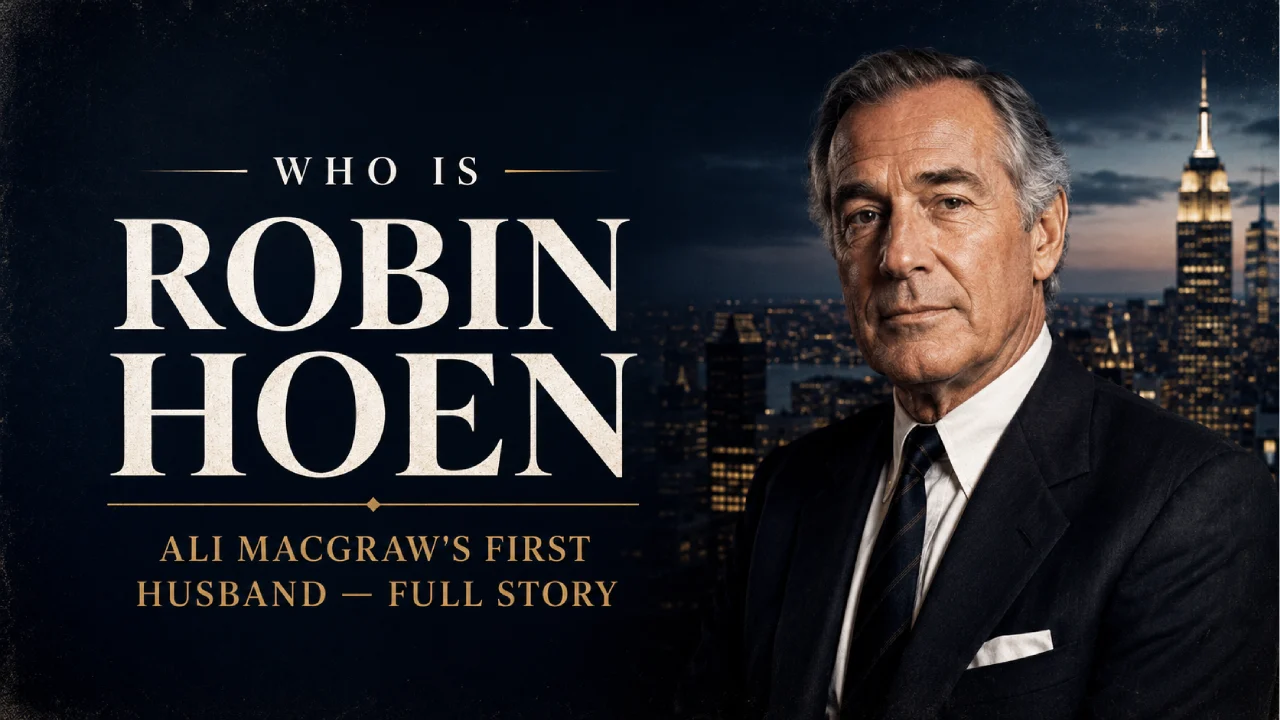
Most people who search for Robin Hoen know one fact about him: he was Ali MacGraw‘s first husband. But that single biographical connection is the least interesting thing about him. Robin Hoen — full name Robert “Robin” Martin Hoen — was a Harvard-educated international banker who rose to Vice President at Chase Manhattan Bank and Chief Operating Officer at Equator Bank, contributed to the US–South Africa Leadership Exchange Program, and spent his entire adult life deliberately outside the spotlight that his brief early marriage to one of Hollywood’s most iconic faces made available to him. He was born on March 18, 1937 in Montreal, Quebec, Canada and died on September 13, 2016 in Grantham, New Hampshire, aged 79. This is his complete story.
Robin Hoen was a German-Canadian banker and international finance professional whose name became widely searchable because of his brief marriage to Ali MacGraw — the actress who defined a particular kind of 1970s American glamour through her performances in Love Story (1970) and The Getaway (1972), and whose face graced the covers of Vogue, Harper’s Bazaar, and Life throughout the decade.
But Robin Hoen’s story predates and outlasts that one-year marriage by decades. He was a serious, educated professional who built a career in international banking at a time when that field required genuine intellectual depth, global fluency, and the kind of disciplined analytical thinking that does not develop overnight. His work at Chase Manhattan Bank and Equator Bank placed him among the senior practitioners of international finance in the mid-twentieth century — a world entirely removed from Hollywood’s cameras and award ceremonies.
He is one of the private figures we document regularly at TattooGleam — men and women who lived full, accomplished lives adjacent to celebrity without seeking its benefits. His story sits alongside those of others like James Westley Welch, the quiet first husband whose name Raquel Welch carried for the rest of her life, and Gal Tirosh, Oracle CEO Safra Catz’s intensely private husband — people who chose substance over visibility when both were available.
| Full Name | Robert “Robin” Martin Hoen |
| Date of Birth | March 18, 1937 |
| Date of Death | September 13, 2016 |
| Age at Death | 79 years old |
| Birthplace | Montreal, Quebec, Canada |
| Nationality | German-Canadian |
| Father | Dr. Thomas Hoen |
| Education | Harvard University — BA History, graduated 1959 |
| Profession | International banker |
| Chase Manhattan Bank | Vice President, International Department |
| Equator Bank | Chief Operating Officer |
| Known For | First husband of actress Ali MacGraw |
| Marriage | Ali MacGraw — married 1961, divorced 1962 |
| Final Residence | Grantham, New Hampshire |
| Social Media | None — lived entirely privately |
Robin Hoen was born on March 18, 1937, in Montreal, Quebec, Canada — a city that in the late 1930s was one of North America’s great cosmopolitan centres, a place where French and English cultures coexisted alongside significant German, Jewish, Italian, and Eastern European immigrant communities that had been building Montreal’s commercial and professional life for decades.
His father, Dr. Thomas Hoen, was a significant presence in his early formation. The “Dr.” designation suggests an academic or medical background that would have shaped the household’s orientation toward education, rigour, and professional achievement. In a German-Canadian household of that era — where the cultural traditions of Central Europe met the practical demands of building a life in a new country — the values of discipline, intellectual seriousness, and professional respectability were typically central rather than peripheral.
Montreal in Robin’s childhood was also a city undergoing significant transformation. The postwar economic boom of the late 1940s and 1950s was reshaping Quebec’s commercial landscape, creating new opportunities in banking, law, and international trade that were not available to previous generations. A bright, disciplined child from a professional family in Montreal during this period had access to exceptional educational pathways — and Robin Hoen took full advantage of them.
His trajectory from Montreal to Harvard to the senior levels of international banking is a story that belongs to a specific generation of North American professionals — men who came of age in the postwar economic expansion, whose intellectual formation was shaped by serious academic institutions, and who built careers in the emerging global financial system that the Bretton Woods era created.
Robin Hoen attended and graduated from Harvard University in Cambridge, Massachusetts, completing his degree in History in 1959. Harvard’s History department in the late 1950s was one of the strongest in the world — home to scholars whose work was reshaping how Americans and Europeans understood the nineteenth and twentieth centuries, and whose teaching produced students capable of sustained, evidence-based analysis of complex events and institutions.
Choosing History as a field of study is a revealing choice for someone who would build his career in international banking. History teaches precisely the skills that international finance requires at its highest levels: the ability to understand how institutions evolve over time, how political and economic systems interact, how decisions made in one context produce consequences across decades, and how to read the meaning of events that are not yet finished. A banker who understands the historical roots of the financial systems he navigates is better equipped than one who sees only the current market conditions.
According to Harvard’s institutional history, the university’s network and intellectual culture have consistently produced professionals who move between academic rigour and practical application — lawyers, diplomats, bankers, and executives who bring a depth of understanding to their fields that purely vocational training cannot replicate. Robin Hoen’s subsequent career at Chase Manhattan Bank and Equator Bank reflects exactly this pattern.
Graduating from Harvard in 1959 placed Robin at the precise moment when American international banking was beginning its postwar expansion in earnest. The International Monetary Fund and World Bank established at Bretton Woods in 1944 had stabilised the global financial system. American banks were extending their reach into Europe, Asia, Latin America, and Africa. A young Harvard History graduate with strong analytical skills and a Canadian international perspective was exceptionally well positioned to enter this expanding world.
Chase Manhattan Bank — formed through the 1955 merger of The Chase National Bank and The Bank of Manhattan Company — was in the late 1950s and 1960s one of the most significant financial institutions in the world. Under the leadership of David Rockefeller, who became president in 1961 and chairman in 1969, Chase Manhattan was aggressively expanding its international operations, establishing a presence in countries and financial markets that American banks had not previously served.
Robin Hoen joined this expanding institution and rose to the position of Vice President in the International Department — a title that, at Chase Manhattan in that era, carried genuine weight. The International Department was where the bank’s most complex and consequential work was done: structuring loans to foreign governments and corporations, navigating the regulatory frameworks of multiple jurisdictions simultaneously, managing currency risk across markets with very different levels of stability, and building relationships with the central banks, development institutions, and private sector counterparts that formed the architecture of the postwar international financial system.
Reaching Vice President level in Chase Manhattan’s International Department required demonstrated competence across a wide range of analytical and relationship skills. Robin did not arrive at this position through family connection or institutional advantage. He arrived through the same combination of Harvard preparation and sustained professional performance that characterised his entire career.
His time at Chase Manhattan would have exposed him to the full complexity of postwar international finance — including the development challenges facing newly independent nations in Africa and Asia, the debt management issues of Latin American economies, and the currency and trade dynamics of the European Common Market that was taking shape during this period. This global perspective is visible in his subsequent work at Equator Bank and in his involvement with the US–South Africa Leadership Exchange Program.
After his time at Chase Manhattan Bank, Robin Hoen moved to Equator Bank — a development-focused financial institution — where he served as Chief Operating Officer. As COO, Robin was responsible for the bank’s day-to-day operations, governance, and the execution of its strategic priorities across all departments and geographies.
Equator Bank’s focus on development finance placed Robin’s later career in a distinctly different register from pure commercial banking. Development finance institutions serve markets and needs that conventional commercial banks frequently cannot or will not serve — providing capital to projects and economies at early stages of development where conventional risk-return calculations make standard bank lending impractical. Working in this environment required not just financial expertise but a genuine commitment to the idea that finance can be an instrument of human development rather than purely a mechanism for profit maximisation.
This commitment was also visible in Robin’s involvement with the US–South Africa Leadership Exchange Program. This programme, which operated during a period of significant political tension around South Africa’s apartheid system, focused on building leadership capacity and supporting the development of democratic institutions and civil society in South Africa. Participating in it placed Robin in the company of people who believed that engagement and capacity building, rather than isolation alone, could contribute to positive political change.
The combination of development banking and democratic institution building work paints a picture of Robin Hoen as someone whose professional values extended beyond the accumulation of personal success to include a genuine concern for how financial systems and leadership capacity could serve broader human purposes. That is not a common profile for men of his generation and background, and it deserves to be noted.
Ali MacGraw — born April 1, 1939, in Pound Ridge, New York — is one of the defining faces of American style and cinema in the 1970s. Born Elizabeth Alice MacGraw, she began her career as a fashion assistant and model before transitioning to acting in the late 1960s. Her breakthrough came with the film Goodbye, Columbus (1969), based on the Philip Roth novella, which earned her a Golden Globe Award for Most Promising Newcomer.
Her most iconic role came in Love Story (1970), directed by Arthur Hiller and co-starring Ryan O’Neal — a film that became one of the highest-grossing of its era and produced one of cinema’s most quoted lines. According to her IMDB filmography, the film earned Ali an Academy Award nomination for Best Actress and cemented her status as one of Hollywood’s most recognisable stars of the period.
Her subsequent film work included The Getaway (1972) alongside Steve McQueen — a film that also marked the beginning of her third marriage, to McQueen himself, which lasted from 1973 to 1978. Her marriage history is notable in its own right: Robin Hoen was her first husband (1961–1962), followed by Robert Evans, the powerful Paramount Pictures president (1969–1972), followed by Steve McQueen (1973–1978). Three marriages to three very different kinds of men — a banker, a studio executive, and a superstar actor — across the most dramatic decade of American cultural life.
Beyond her acting career, Ali MacGraw has been a committed yoga practitioner and wellness advocate, and has written openly about her experiences with fame, relationships, and personal growth. Her 1991 memoir Moving Pictures addressed all three marriages with candour and reflection, providing one of the few windows into Robin Hoen’s life from someone who actually knew him during his early adult years.
Robin Hoen and Ali MacGraw married in 1961 — a moment that placed both of them at very early stages of their respective adult lives. Robin was 24, fresh from Harvard and beginning his banking career. Ali was 22, working at Harper’s Bazaar as an assistant, not yet the famous actress she would become — indeed, her first film was still eight years away.
Their meeting appears to have happened in the overlapping social world of young, educated New York professionals of the early 1960s — a world where Harvard graduates, aspiring models, magazine editorial assistants, and art world figures moved in shared social circuits. Both were intelligent, attractive, and moving in the direction of ambitious professional lives. The connection they formed was real, even if the marriage that followed proved short-lived.
The marriage lasted approximately one year. By 1962, the couple had separated and divorced. Both parties have handled the specifics of what ended the marriage with consistent discretion — neither Robin in his subsequent private life nor Ali in her memoir provided detailed accounts of the specific reasons for the separation.
What the timeline suggests is that two young people found each other before they had fully established who they were and what they needed — a circumstance so common in early marriages that it barely requires explanation. Robin was building toward a career in international banking. Ali was finding her way toward the fashion and entertainment worlds that would define her public identity. Their paths, once they became clearer to both of them, were pointed in different directions.
After his divorce from Ali MacGraw in 1962, Robin Hoen’s trajectory diverged completely from Hollywood’s orbit. While Ali’s career was building toward its 1969–1970 peak — Goodbye, Columbus, then Love Story, then marriage to Robert Evans and all the Paramount Pictures glamour that accompanied that union — Robin was doing something entirely different.
He was working. Building his career in international banking. Rising through Chase Manhattan Bank’s International Department. Developing the expertise and institutional relationships that eventually carried him to the COO position at Equator Bank. Contributing to leadership programmes. Building a life in New Hampshire that bore no resemblance to the Beverly Hills world that surrounded his former wife.
The contrast between their post-divorce trajectories is striking not because one is more impressive than the other — both represent genuine achievement in their respective domains — but because of how completely Robin chose his own path rather than the alternative that was structurally available to him. He could have leveraged the Ali MacGraw connection when it became famous. He could have given interviews. He could have attended the events that his former marriage would have provided access to. He chose none of that. He chose banking, and he chose New Hampshire, and he chose quiet.
This pattern of deliberate post-divorce privacy has resonances with other figures we have profiled — particularly Pastor Steven Cauble, who handled his divorce from actress Lisa Whelchel after 24 years with such grace and discretion that they remained best friends, and Jan Schiltmeijer, the Dutch painter who maintained complete privacy through and after his 13-year marriage to comedian Amber Ruffin.
Grantham, New Hampshire — the small town in Sullivan County where Robin Hoen spent his later years — is as different from Manhattan banking culture and Hollywood celebrity as it is possible to be while remaining in the continental United States. With a population of approximately 3,000 people, situated in the Connecticut River Valley, Grantham is a place of quiet natural beauty, small community institutions, and the specific kind of New England life where a person can be entirely known within a small radius and entirely unknown beyond it.
For someone who had spent his career navigating the complex international financial landscape from New York, the choice of Grantham as a place to spend his final decades suggests a genuine desire for simplicity and community rather than continued professional engagement or public profile. It is the choice of someone who built what he built and was satisfied with it, ready to live quietly with whatever accumulated wisdom those decades had produced.
No detailed account of his life in Grantham is publicly available — which is exactly as he would have wanted it. He maintained no social media presence. He gave no interviews. He did not appear in any public records beyond the essential documents of civic life. He was a private citizen in the fullest sense of the phrase, living in a small New Hampshire town, known to his neighbours and community as Robin Hoen rather than as Ali MacGraw’s first husband.
Robin Hoen’s career — at Chase Manhattan Bank’s International Department in New York in the 1960s — places him at the centre of one of the most culturally significant moments in American history. The New York of the early 1960s that Robin inhabited as a young international banker was the same New York that was simultaneously producing the pop art revolution at Leo Castelli Gallery, hosting the folk revival at Greenwich Village‘s Café Wha? and Bitter End, and nurturing the fashion world in which the young Ali MacGraw was building her career at Harper’s Bazaar.
The financial world and the creative world occupied the same city in that era but rarely the same rooms — Wall Street and SoHo were physically close and culturally distant. The international banking culture Robin inhabited was conservative, formal, and defined by institutional relationship and analytical rigour. The fashion and early entertainment culture Ali was entering was experimental, image-driven, and defined by youth and visual impact.
The visual culture of that era — including its relationship to body modification and tattoo art — was itself undergoing transformation. Tattooing in early 1960s New York was still primarily associated with working-class and military communities, with the sailor tattoo tradition that had characterised American tattooing since the nineteenth century. The crossover into mainstream culture that would eventually make tattoos ubiquitous was still a decade away. The New York that Robin and Ali briefly shared in 1961–1962 was a city where tattoo culture and banking culture existed in genuinely separate worlds.
Today, those worlds overlap significantly — financial professionals are tattooed, tattoo artists manage businesses with sophisticated financial needs, and the culture that connects body art to personal identity has permeated virtually every professional and social context. Our complete 2026 guide on what to use for tattoo aftercare covers the best products for every stage of healing. The day-by-day healing stages guide tells you exactly what to expect through full recovery. If your tattoo is feeling dry during healing, our article on why a tattoo feels dry after moisturizing explains what is happening. The full TattooGleam aftercare library covers every stage of care.
Robin Hoen passed away on September 13, 2016, in Grantham, New Hampshire, after a period of illness. He was 79 years old. His death did not produce newspaper obituaries in major publications, did not generate celebrity tributes, and did not become a media event. It was a private death — appropriately consistent with the private life he had chosen to live for more than five decades after his brief moment of public connection to Hollywood through his marriage to Ali MacGraw.
What Robin Hoen left behind was a career built on genuine intellectual achievement and professional integrity, a demonstrated commitment to values beyond personal advancement through his development banking work and leadership programme participation, and a life that was his own — not defined by the famous name he was briefly connected to, not shaped by the spotlight that was momentarily available to him, and not reduced to the single biographical footnote that most people know him by.
His legacy, in the most accurate sense, is the sum of what he actually did: the international transactions he managed at Chase Manhattan, the operational decisions he made at Equator Bank, the leadership development work he contributed to in South Africa, and the quiet decades in Grantham where he lived as himself rather than as someone else’s story.
That, ultimately, is more than most people leave behind — even those who spend their lives trying to be remembered.
Who was Robin Hoen?
Robin Hoen — full name Robert “Robin” Martin Hoen — was a German-Canadian international banker born on March 18, 1937, in Montreal, Quebec. He graduated from Harvard University with a degree in History in 1959, built a career as Vice President in the International Department at Chase Manhattan Bank and later as Chief Operating Officer at Equator Bank, and was involved in the US–South Africa Leadership Exchange Program. He is best known publicly as the first husband of actress Ali MacGraw. He died on September 13, 2016, in Grantham, New Hampshire, aged 79.
Did Robin Hoen and Ali MacGraw have children?
No. Robin Hoen and Ali MacGraw did not have children together. Their marriage lasted approximately one year — from 1961 to 1962 — which was too brief for children to be part of the picture. Ali MacGraw’s son, Josh Evans, was born from her second marriage to Paramount Pictures president Robert Evans.
Why did Robin Hoen and Ali MacGraw divorce?
The specific reasons for their 1962 divorce were never publicly detailed by either party. The most plausible explanation, consistent with what both have indicated indirectly, is that they were at very early stages of their adult lives with diverging professional and personal trajectories. Robin was building toward a career in international banking; Ali was moving toward fashion and eventually acting. Their paths simply pointed in different directions, and they separated without drama or public recrimination.
What did Robin Hoen do at Chase Manhattan Bank?
Robin Hoen served as Vice President in the International Department at Chase Manhattan Bank. In this role, he worked on global banking matters — structuring international loans, managing relationships with foreign governments and financial institutions, navigating multi-jurisdictional regulatory frameworks, and contributing to the bank’s expanding international presence during the postwar era of global financial development under the leadership of David Rockefeller.
What was Equator Bank and what did Robin Hoen do there?
Equator Bank was a development-focused financial institution. Robin Hoen served as its Chief Operating Officer — responsible for the bank’s day-to-day operations, governance, and strategic execution. Development banking differs from commercial banking in its focus on providing capital to markets and projects that standard commercial risk assessment typically underserves, making it a field that attracted professionals with both financial expertise and a genuine interest in development outcomes.
Where did Robin Hoen live later in life?
In his later years, Robin Hoen lived in Grantham, New Hampshire — a small town in Sullivan County with a population of approximately 3,000 people. He spent his final decades there in complete privacy, far from the Manhattan banking world and Hollywood celebrity orbit he had been connected to in earlier life. He died in Grantham on September 13, 2016.
Did Ali MacGraw write about Robin Hoen in her memoir?
Yes. Ali MacGraw addressed her first marriage to Robin Hoen in her 1991 memoir Moving Pictures. She wrote about the relationship with warmth and retrospective understanding — describing it as a young person’s choice made before she fully knew herself, and characterising Robin as a genuinely good person whose life took a different direction from hers. The memoir’s treatment of him was respectful and affectionate, consistent with how both parties navigated the divorce itself.
Note: This article is a biographical piece for informational purposes only. All facts are drawn from publicly available sources and published memoirs. For tattoo aftercare guides and healing resources, visit tattoogleam.com.
TattooGleam Editorial Team
Tattoo aftercare experts · tattoogleam.com