September 4, 2026

In This Article
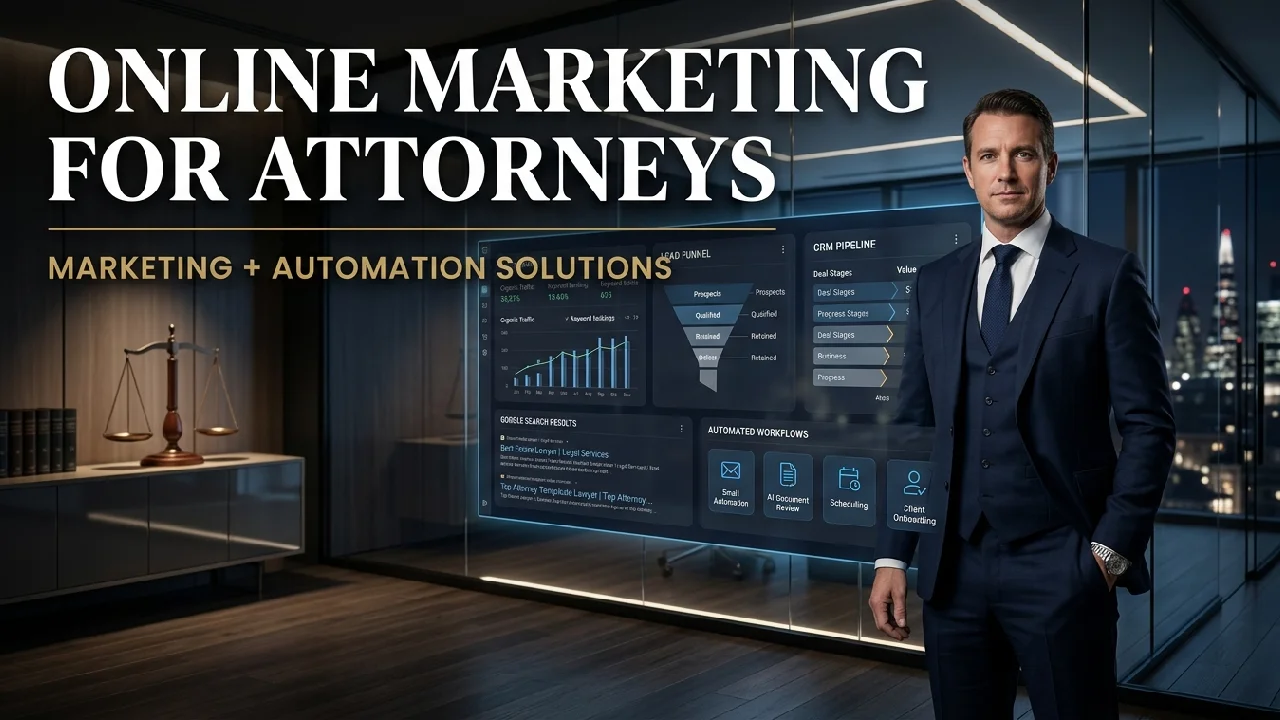
Online marketing and automation solutions for attorneys bring together digital channels such as SEO, paid advertising, social media, email, reputation management, CRM systems, and automated lead follow-up. The goal is simple: help potential clients discover the right law firm, make contact easily, and receive a timely response without forcing attorneys or staff to manage every step manually.
Legal marketing has changed significantly. A prospective client may discover a firm through Google, read several practice-area pages, check reviews, compare attorneys on social platforms, and submit an enquiry without ever making a traditional phone call first.
That creates both an opportunity and a problem. A strong online presence can generate valuable enquiries, but those enquiries can be lost when forms are not monitored, calls go unanswered, or follow-up depends entirely on someone remembering to send an email.
Marketing automation addresses that gap. Instead of treating marketing and intake as separate activities, a law firm can connect visibility, lead capture, follow-up, scheduling, and reporting into one measurable process.
Online marketing for attorneys is the use of digital channels to build visibility, establish credibility, attract prospective clients, and generate enquiries for a law firm.
It can include:
The best strategy does not treat these channels as isolated campaigns. SEO should send visitors to useful pages. Those pages should make contacting the firm easy. The enquiry should enter a structured intake process, and the firm should be able to measure what happened afterward.
That connection between marketing and intake is where automation becomes particularly valuable.
Attorneys have a difficult marketing environment. Legal work is time-sensitive, staff may be handling several matters at once, and prospective clients can contact a firm outside normal office hours.
A potential client who submits a form at 10 p.m. may not wait until the next afternoon before contacting another firm. A person searching for a personal injury lawyer, immigration attorney, divorce lawyer, or criminal defense attorney may have several options available with only a few clicks.
Marketing automation helps reduce these gaps by handling repetitive processes consistently.
| Without Automation | With Automation |
|---|---|
| Staff manually check new enquiries | New leads trigger immediate notifications |
| Follow-up depends on individual staff members | Predefined follow-up workflows run consistently |
| Leads may be scattered across inboxes | Leads are organized inside a CRM |
| Appointments require manual coordination | Qualified prospects can receive scheduling options |
| Marketing results are difficult to connect to cases | Leads and marketing sources can be tracked through the funnel |
The objective is not to automate every interaction. It is to automate predictable tasks while keeping attorneys and intake staff responsible for conversations that require professional judgment.
A complete legal marketing system usually combines several components rather than relying on one tool.
SEO helps law firms appear when people search for legal information or legal services. Strong legal SEO can include practice-area pages, location pages, educational content, technical optimization, internal linking, structured data, local SEO, and authoritative references.
PPC can put a firm’s services in front of people actively searching for legal help. Campaigns can be organized around practice area, location, search intent, and landing-page experience.
Forms, phone calls, chat, appointment requests, and other contact methods give prospective clients a way to raise their hand. The goal is to make that first step clear and easy.
A CRM can centralize prospective-client information, track lead sources, organize follow-up, and help staff understand where each enquiry sits in the intake process.
Automated communication can acknowledge an enquiry, provide approved information, remind prospects about appointments, and support longer-term nurturing when someone is not ready to move forward immediately.
Reviews are an important part of online reputation. Firms can use systems to request reviews appropriately, monitor new feedback, and alert staff when a response requires human attention.
AI can assist with content development, classification, summarization, chat, lead routing, and other repetitive activities. However, legal marketing requires human oversight because automated content can create accuracy, confidentiality, advertising, or unauthorized-practice concerns.
SEO remains one of the most valuable long-term online marketing channels for attorneys because it can capture people who are already searching for answers or legal representation.
A law firm should build content around the questions and problems its target clients actually search for.
For example, a personal injury practice could create useful resources around accident claims, evidence, settlement processes, insurance questions, and local legal considerations. A family law firm could develop content around divorce, custody, support, mediation, and related processes.
The goal should not be to publish hundreds of generic articles. A stronger strategy is to create authoritative topic clusters that connect educational content with relevant practice-area pages.
Many legal searches include a location or have strong local intent. A person may search for an attorney in a city, county, or specific jurisdiction.
Local SEO can include:
The objective is to make the firm easy to discover and easy to evaluate when someone has local legal intent.
Paid advertising can provide faster visibility than organic search, particularly in competitive legal markets.
However, expensive clicks do not automatically produce valuable clients. A successful PPC strategy needs to connect the advertisement with a relevant landing page and an efficient intake process.
A simplified journey might look like this:
Search → Ad → Landing Page → Contact → Intake → Consultation → Matter
If the landing page is confusing, the form is too long, or nobody follows up with the lead, advertising spend can be wasted even when the campaign generates traffic.
Attorneys should therefore evaluate paid campaigns using business outcomes rather than clicks alone.
Lead capture is the point where marketing turns into a potential business opportunity.
Law firms can capture prospective clients through:
Once an enquiry arrives, automation can perform basic administrative tasks. For example, the system can record the source, notify the appropriate intake employee, send an acknowledgement, and create a follow-up task.
More advanced systems can use approved qualification questions to determine the appropriate routing path. The important distinction is that automation should support intake rather than independently provide legal advice.
A CRM gives a law firm a centralized view of prospective-client interactions.
Instead of relying on spreadsheets and individual inboxes, staff can see information such as:
CRM data also makes marketing decisions more intelligent. Instead of concluding that a campaign worked because it generated many form submissions, a firm can compare which sources generated qualified consultations and eventually valuable matters.
Email and SMS automation can help law firms maintain consistent communication without requiring staff to manually send every message.
Potential workflows include:
| Trigger | Possible Workflow |
|---|---|
| New website enquiry | Send acknowledgement and notify intake |
| Consultation booked | Send confirmation and approved reminder |
| Missed appointment | Send approved rescheduling instructions |
| Unresponsive enquiry | Start an appropriate follow-up sequence |
| Marketing subscriber | Send educational content according to consent and preferences |
Automation should always respect consent requirements, communication preferences, and applicable professional rules.
AI is expanding the possibilities of legal marketing automation. Instead of only triggering fixed messages, AI-based systems can help classify information, summarize enquiries, generate content drafts, personalize approved communications, and assist with conversational interfaces.
For marketing teams, AI can help turn one authoritative piece of content into multiple formats. A detailed article could become a newsletter, a social post, a video outline, a list of FAQs, and several short educational pieces.
The American Bar Association has also discussed the use of generative AI in legal marketing, emphasizing that AI-generated marketing content still needs to comply with professional conduct requirements and should be reviewed for misleading claims and other risks. ABA guidance on AI marketing provides additional context.
An AI chatbot can answer basic questions and guide website visitors toward an appropriate next step. But law firms should be particularly careful with automated legal conversations.
A chatbot should not create the impression that a visitor has received legal advice or that an attorney-client relationship has automatically been established. The system should also be designed with appropriate privacy, confidentiality, escalation, and disclaimer controls.
The ABA specifically warns that lawyers supervising AI tools remain responsible for their use and recommends reviewing chatbot scripts and using prominent disclaimers where appropriate. Attorney advertising and AI guidance explains these concerns in more detail.
Reputation is an important part of legal marketing because prospective clients often evaluate a firm before making contact.
Automation can help organize review requests and notify staff when new reviews appear. However, firms should avoid treating reputation management as a purely automated process.
Positive reviews can strengthen trust, while negative reviews require careful handling. Attorneys have professional confidentiality obligations, so publicly responding to a negative review can create risks if the response reveals information about a representation.
The ABA notes that a lawyer’s duty of confidentiality generally does not disappear simply because a former or current client posts information publicly. ABA’s digital advertising FAQ discusses how firms should approach online reviews.
The strongest online marketing and automation solutions for attorneys connect multiple stages rather than automating isolated tasks.
Use SEO, local search, paid advertising, social media, referrals, directories, and educational content to attract the right audience.
Give visitors useful information about their problem, the firm’s practice area, and the next steps they can take. Helpful content can build confidence before someone makes contact.
Provide clear calls to action, contact forms, phone numbers, chat, and consultation options.
Send an immediate approved acknowledgement and alert the appropriate member of the intake team.
Use approved intake questions and human review to determine whether the enquiry fits the firm’s practice area, jurisdiction, availability, and intake criteria.
When appropriate, provide consultation scheduling options and reminders.
Prospects who are not ready to proceed can enter an appropriate educational or follow-up sequence where permitted.
Connect marketing-source information with consultation and matter outcomes wherever the firm’s systems and privacy practices allow.
Automation does not remove an attorney’s professional responsibilities. In fact, automation can make oversight even more important because one incorrect workflow can distribute the same problem across many communications.
The American Bar Association’s Model Rules address attorney advertising, solicitation, confidentiality, supervision, and technology-related responsibilities. State rules can differ, so attorneys should review the requirements applicable to their jurisdiction.
Marketing claims should be accurate and should not create misleading impressions about a lawyer’s services, experience, results, or capabilities.
Marketing vendors and automation platforms do not take away the firm’s responsibility for its advertising. The ABA notes that attorneys who delegate marketing still have obligations concerning compliance and supervision.
The ABA’s internet marketing ethics guidance explains why attorneys should establish review and approval processes for digital marketing.
Marketing systems should not expose confidential client information. Firms should understand how vendors store, process, transmit, and retain information before connecting sensitive data to an automation platform.
AI-generated content should be reviewed for factual accuracy, misleading statements, confidentiality concerns, inappropriate legal advice, and compliance with applicable advertising rules.
If a law firm uses an AI chatbot, the visitor should be clearly informed that they are interacting with an automated system and that the tool does not itself provide legal advice or establish an attorney-client relationship.
Because legal advertising requirements can vary by state, firms should obtain jurisdiction-specific professional guidance rather than assuming that one compliance approach applies everywhere.
A law firm’s marketing dashboard should go beyond impressions and website traffic. Those metrics can be useful, but they do not necessarily show whether marketing is producing worthwhile business.
| Metric | Why It Matters |
|---|---|
| Organic traffic | Shows search visibility and content reach |
| Qualified leads | Measures the quality of marketing-generated enquiries |
| Cost per lead | Shows acquisition efficiency |
| Consultation rate | Shows how effectively leads move into consultations |
| Show-up rate | Shows whether scheduled consultations actually occur |
| Client conversion rate | Shows how many qualified opportunities become clients |
| Cost per acquired client | Provides a stronger business-level view of marketing efficiency |
The most useful reporting connects marketing source to meaningful outcomes. A campaign that produces fewer leads but substantially better consultations may be more valuable than a campaign generating a large volume of low-quality enquiries.
Automation cannot fix a confusing website, poor landing page, unclear service offering, or weak intake process. Fix the underlying experience before adding more technology.
Publishing large amounts of shallow AI-generated content can weaken a firm’s credibility. Legal audiences need accurate, useful, jurisdiction-aware information.
A law firm can have excellent national content and still miss valuable local opportunities. Location, jurisdiction, reviews, and local relevance matter for many legal searches.
Automation should improve communication, not overwhelm prospective clients. Every message should have a clear purpose and comply with applicable communication requirements.
AI can produce inaccurate or misleading statements. Human review is especially important when content discusses legal issues, case outcomes, attorney experience, or client matters.
Traffic, impressions, followers, and clicks can be useful indicators, but law firms ultimately need to understand whether marketing is producing qualified opportunities and sustainable business results.
There is no single platform that is best for every law firm. A solo attorney with one practice area may need a much simpler setup than a multi-location firm with a dedicated marketing and intake department.
Before choosing a platform, agency, or combination of tools, evaluate:
The best technology is not necessarily the one with the largest feature list. It is the one that fits the firm’s actual workflow and helps reduce measurable friction.
Online marketing and automation solutions for attorneys work best when they are treated as one connected growth system.
SEO attracts someone searching for information. A well-designed page builds confidence. A clear call to action captures the enquiry. Automation makes sure the enquiry enters the correct workflow. The CRM gives staff visibility. Follow-up keeps communication organized. Analytics shows which channels are generating meaningful opportunities.
This approach is more sustainable than simply buying traffic or publishing content without understanding what happens after someone arrives on the website.
The same principle applies to AI. AI should not be added simply because it is fashionable. It should solve a specific problem, operate within clear boundaries, and remain subject to appropriate human oversight.
What are online marketing and automation solutions for attorneys?
They are connected digital marketing and workflow systems that help law firms attract potential clients, capture enquiries, manage leads, automate appropriate follow-up, schedule consultations, and measure marketing performance. Common components include SEO, PPC, CRM, email, SMS, social media, reputation management, chat, and AI-assisted workflows.
What is the best online marketing strategy for a law firm?
There is no universal strategy. Most firms benefit from a combination of local SEO, practice-area content, conversion-focused website pages, reputation management, paid search where appropriate, and structured lead intake. The right mix depends on the firm’s practice areas, location, competition, budget, and target clients.
How can attorneys automate lead follow-up?
A firm can connect website forms, calls, chat, or advertising leads to a CRM and create approved workflows for acknowledgement, notifications, reminders, scheduling, and appropriate follow-up. Human staff should remain involved when professional judgment or legal advice is required.
Can AI be used for law firm marketing?
Yes. AI can assist with content drafting, content repurposing, research organization, lead classification, chat, and other marketing tasks. However, AI-generated material should be reviewed for accuracy, confidentiality, misleading claims, legal advice concerns, and compliance with applicable professional rules.
Should law firms use automated chatbots?
Chatbots can help with basic website navigation and intake support, but law firms should configure them carefully. Visitors should understand that the system is automated and cannot provide legal advice, and the workflow should include appropriate disclaimers, escalation, privacy, and confidentiality safeguards.
Why is SEO important for attorneys?
SEO helps law firms become visible when people search for legal information and services. Practice-area content, local SEO, technical optimization, useful resources, and strong website structure can help a firm attract relevant organic traffic over time.
What should attorneys measure in digital marketing?
Important metrics include qualified leads, consultation bookings, consultation show-up rates, client conversion rates, cost per lead, cost per acquired client, organic traffic, paid advertising performance, and the marketing source associated with new business.
Is legal marketing automation compliant?
Automation itself is not inherently non-compliant, but the way it is configured and used matters. Attorneys remain responsible for applicable advertising, solicitation, confidentiality, privacy, and professional-conduct requirements. Rules can vary by jurisdiction, so firms should review their applicable state requirements and obtain professional advice when necessary.
The American Bar Association’s AI marketing guidance discusses how lawyers can use generative AI for marketing while maintaining professional and ethical responsibilities.
The ABA’s digital advertising and ethics FAQ covers online advertising, third-party marketing providers, AI chatbots, social media, reviews, and attorney responsibilities.
For broader guidance on managing online marketing responsibly, see the ABA’s internet marketing ethics guidance.
The ABA’s guidance on AI in law firm marketing also addresses AI-generated advertising, internal policies, confidentiality, and review requirements.
Disclaimer: This article is for general informational purposes only and does not constitute legal, ethical, advertising, or professional advice. Attorney advertising and solicitation requirements vary by jurisdiction. Law firms should review the rules applicable to their practice locations and obtain appropriate professional guidance before implementing automated marketing, AI, SMS, email, chatbot, or lead-generation workflows.
TattooGleam Editorial Team
tattoogleam.com