
September 2, 2026

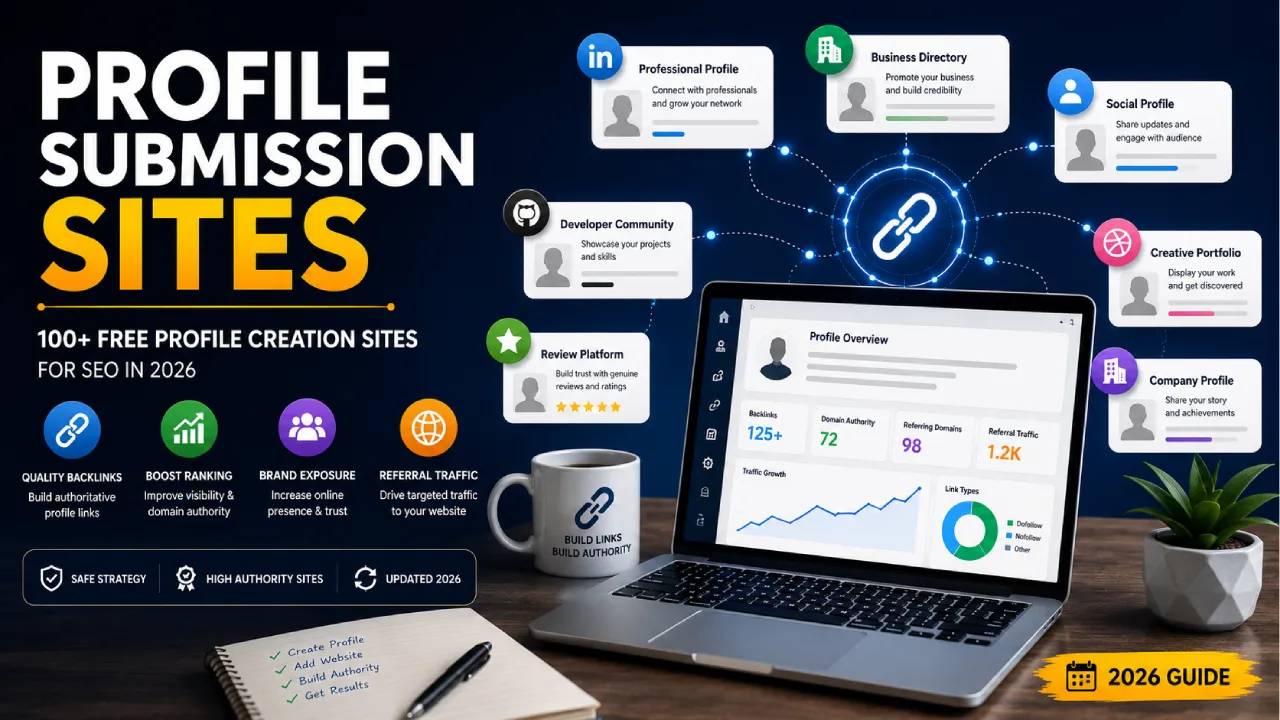
Profile submission sites are platforms where individuals, businesses, professionals, creators, and organizations can create public profiles containing information such as a name, description, website, social accounts, company details, portfolio, or professional experience.
For SEO professionals, profile creation can be useful for building a consistent online presence, generating referral opportunities, improving brand discoverability, and creating legitimate references to a website. However, profile links should be treated as one part of a broader SEO strategy rather than a shortcut to higher rankings.
This guide covers the best types of profile submission sites, more than 100 platforms to consider, profile backlink best practices, optimization techniques, and mistakes to avoid in 2026.
Profile submission sites are online platforms that allow users or organizations to create public profile pages. Depending on the platform, a profile may include your name, company information, biography, professional experience, services, portfolio, social accounts, and website URL.
Examples include professional networks, social platforms, business directories, developer communities, creative portfolios, startup databases, review websites, and industry-specific communities.
The strongest profiles are not created simply to obtain a backlink. They represent a real person, company, project, or brand and provide useful information to visitors.
Profile creation can support SEO in several ways. The biggest benefit is often not the backlink itself but the wider online presence created around a brand.
A profile on a platform that people actually use is generally more valuable than dozens of abandoned profiles on low-quality websites.
Many platforms allow users to add a website URL to their profile, biography, portfolio, company description, or business information. When the profile becomes publicly accessible, that URL may function as a backlink to the website.
The SEO value of these links varies significantly. Some links may be nofollow, sponsored, user-generated, redirected, or otherwise treated differently by search engines.
Therefore, it is better to focus on the quality and relevance of the platform rather than building a large number of profile links as quickly as possible.
Below is a practical list of platforms that can be considered for profile creation. Availability, profile rules, visibility, and link attributes can change, so always check the current platform requirements before submitting.
| # | Platform | Best For |
|---|---|---|
| 1 | Professional profiles | |
| 2 | Personal and business presence | |
| 3 | Brands and creators | |
| 4 | X | Personal brands and businesses |
| 5 | Visual brands | |
| 6 | YouTube | Creators and businesses |
| 7 | GitHub | Developers and technology brands |
| 8 | Behance | Designers and creatives |
| 9 | Dribbble | Design professionals |
| 10 | Medium | Writers and publishers |
| 11 | Quora | Experts and communities |
| 12 | Community participation | |
| 13 | About.me | Personal brands |
| 14 | Gravatar | Author identity |
| 15 | Crunchbase | Companies and startups |
| 16 | Product Hunt | Products and startups |
| 17 | Wellfound | Startups and professionals |
| 18 | Clutch | Agencies and service companies |
| 19 | G2 | Software companies |
| 20 | Trustpilot | Businesses and customer reviews |
These platforms should be selected according to your business type. There is no SEO advantage in creating every possible profile if your brand has no genuine reason to use the platform.
Professional networks are particularly useful for consultants, marketers, freelancers, executives, agencies, recruiters, and professionals building personal brands.
Businesses should prioritize platforms that help customers find, evaluate, or contact them. Local businesses should also maintain accurate business information across important local platforms.
Google Business Profile is particularly important for eligible local businesses because a verified profile can appear across Google Search and Maps. Google states that creating a Business Profile is free and allows businesses to manage information, photos, and customer interactions.
Developers, designers, photographers, writers, and other creatives can benefit from profiles that showcase actual work instead of relying only on traditional directory listings.
Review and community platforms can be valuable because they combine profile information with user-generated content and reputation signals.
Community profiles should be used naturally. Posting promotional links repeatedly or adding keyword-heavy profile information can make an otherwise useful account look artificial.
Startups and technology companies can create profiles on platforms that document businesses, products, founders, funding, and company activity.
For example, Crunchbase allows registered and socially authenticated users to create profile pages. Its own guidance recommends completing company information such as the logo, website, description, location, industries, founders, and other relevant information.
Many popular platforms offer free account or profile options, although some may place advanced features behind paid plans.
| Platform | Profile Type |
|---|---|
| Professional | |
| GitHub | Developer |
| Behance | Creative |
| Dribbble | Designer |
| Medium | Writer |
| Quora | Expert/Community |
| Community | |
| Visual Brand | |
| YouTube | Creator/Business |
| Product Hunt | Product/Startup |
| About.me | Personal Brand |
| Gravatar | Identity/Author |
| GitLab | Developer |
| CodePen | Developer |
| Flickr | Photography |
Some profile platforms allow website links, while others limit external links or apply attributes such as nofollow or sponsored. Some profile URLs may also be hidden from search engines or visible only after login.
Because of this, you should never assume that every profile submission creates an SEO-passing backlink.
A better approach is to consider profile links as part of a diversified digital presence that includes editorial links, relevant directories, citations, digital PR, useful content, and genuine community participation.
SEO professionals often categorize profile links as dofollow or nofollow. However, the attribute alone should not determine whether a platform is worth using.
A nofollow profile link can still generate referral traffic, brand discovery, credibility, and additional visibility. Likewise, a dofollow link from a low-quality website may have little practical value.
Google specifically warns against low-quality directory or bookmark links and automated link-building practices designed primarily to manipulate rankings.
Follow these steps when creating a new profile:
A complete profile is more useful than a page containing only a website URL. Optimize each profile as a genuine representation of your brand.
Keep your business name, website, company description, location, and other core information consistent where appropriate.
Avoid copying the same keyword-stuffed description across 100 websites. Create a concise description that explains what you or your business actually does.
If the platform allows website and social links, add only destinations that are genuinely connected to the profile.
Add your logo, photograph, services, skills, portfolio, company details, and other relevant information whenever those fields are available.
Google lists low-quality directory and bookmark links, automated link creation, and other manipulative linking practices among its spam policies.
The safest approach is to build profiles gradually and prioritize platforms that have a legitimate purpose for your business.
Create your most important professional, social, and business profiles first.
Find directories, communities, marketplaces, and review platforms that are genuinely relevant to your industry.
A smaller number of complete profiles is usually more useful than a huge collection of empty accounts.
Combine profile creation with digital PR, editorial mentions, useful resources, partnerships, industry publications, and quality content.
Track referral traffic, branded searches, indexed profile pages, referring domains, and conversions rather than simply counting links.
Create a simple spreadsheet to record every profile you create.
| Field | Example |
|---|---|
| Platform | |
| Profile URL | Public profile URL |
| Website Added | Yes |
| Profile Status | Live |
| Link Type | Platform dependent |
| Date Created | September 2026 |
The following expanded list gives SEO professionals more options to evaluate. Always verify whether a platform currently accepts public profiles and external website links before submitting.
Not every platform above should be treated as a traditional SEO “profile backlink site.” Some are social networks, portfolio platforms, developer communities, business directories, review platforms, or publishing services. Choose platforms based on relevance and actual usefulness rather than creating every profile on the list.
Profile submission sites are platforms where individuals or businesses can create public profiles containing information such as a biography, company details, professional experience, social links, or website URL.
They can support SEO as part of a broader strategy by improving brand visibility, creating legitimate online profiles, generating referral opportunities, and supporting consistent business information. They should not be treated as a standalone ranking tactic.
No. Link attributes vary by platform. Some links may be nofollow, sponsored, user-generated, redirected, or otherwise treated differently by search engines.
There is no ideal number. Start with the platforms most relevant to your business, industry, location, profession, or audience instead of submitting to hundreds of unrelated websites.
A profile backlink should not be expected to directly improve rankings simply because it exists. The overall quality, relevance, context, and legitimacy of your online presence matter more than the number of profile links.
Free does not automatically mean safe or valuable. Evaluate the platform, its reputation, moderation, relevance, profile quality, and whether users genuinely use it before creating an account.
Your core business information can remain consistent, but avoid publishing a keyword-stuffed identical description across dozens of platforms. Adapt your profile naturally to each platform.
A diversified strategy combining useful content, relevant industry profiles, digital PR, editorial mentions, local citations, partnerships, and genuine community participation is generally stronger than mass profile creation alone.
Profile submission sites can be a useful part of an SEO and digital marketing strategy when they are used to establish genuine professional, business, or brand profiles.
The goal should not be to create hundreds of low-quality backlinks. Instead, identify platforms where your customers, industry peers, partners, or professional community are actually present.
Create complete profiles, maintain consistent brand information, add relevant website links where appropriate, and combine profile creation with stronger link acquisition methods such as editorial content, digital PR, industry publications, and useful resources.
In 2026, quality, relevance, and authenticity are more important than simply increasing the number of referring domains.



Social Profile Submission Sites
Social networks are among the easiest places to establish a consistent brand identity. They can also provide referral traffic and help users discover your website.
Do not create social profiles simply to place a URL. Use the accounts to publish useful updates, interact with audiences, and build a genuine brand presence.