
September 4, 2026

In This Article
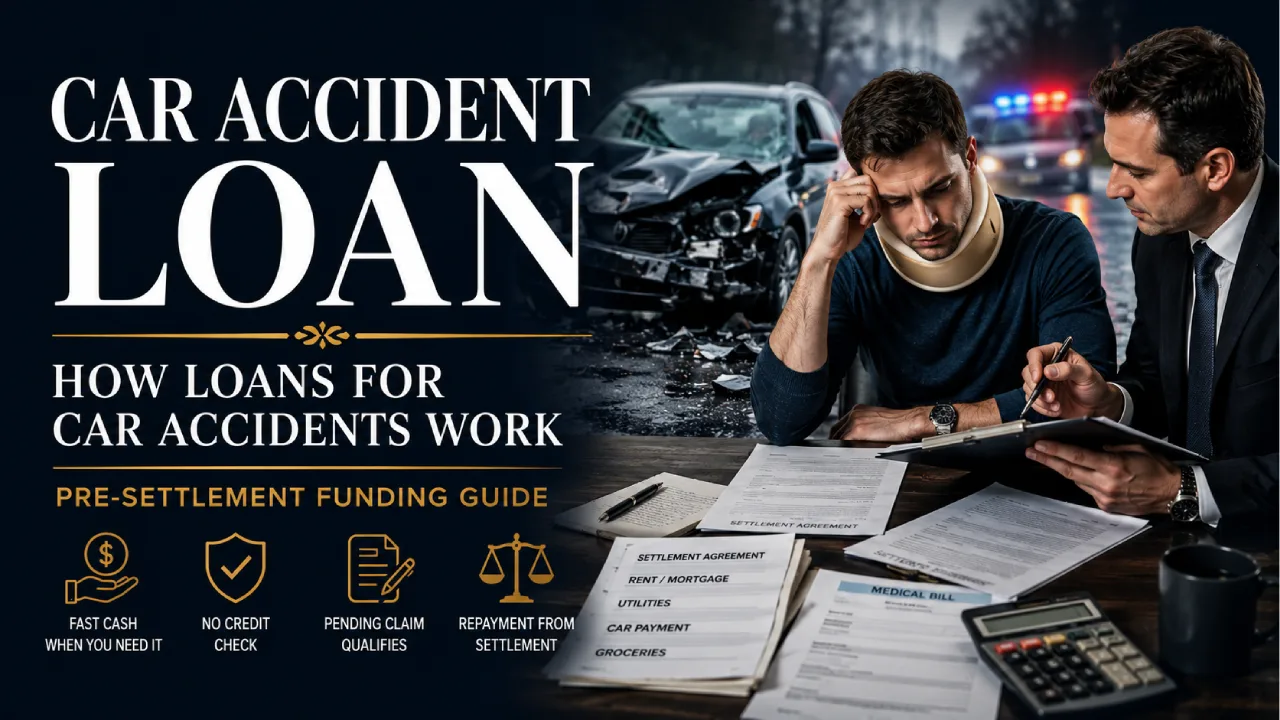
A car accident can create financial pressure long before an insurance claim or personal injury settlement is resolved. Medical bills, rent, car payments, groceries, and lost income can continue while you wait for your case to move forward. For people in this situation, a car accident loan or pre-settlement funding may provide access to money before a claim is settled.
But the term “car accident loan” can be confusing. Some products are structured as loans, while many forms of accident settlement funding are structured as an advance or purchase of a portion of the expected proceeds from a legal claim. The exact structure, cost, repayment rules, and availability can depend on where you live and the provider you choose.
This guide explains how loans for car accidents can work, who may qualify, what the application process looks like, what the money may be used for, and what you should consider before accepting funding.
| Also Called | Pre-settlement funding, lawsuit funding, or accident settlement funding |
| Typical Applicant | An injured person with a pending personal injury claim and legal representation |
| Purpose | Help cover eligible personal and household expenses while waiting for a settlement |
| Credit Check | Eligibility for pre-settlement funding is generally focused on the legal claim rather than traditional creditworthiness |
| Repayment | Depends on the agreement and whether the product is structured as funding or a loan |
| Main Consideration | Understand the total cost and repayment terms before accepting the money |
| Important Step | Review the agreement carefully and discuss it with your attorney |
A car accident loan is a general term people may use when looking for financial assistance after an accident while a personal injury claim is still pending. In practice, the product may be a traditional loan, a lawsuit loan, or pre-settlement funding rather than a conventional personal loan from a bank.
This distinction matters because the repayment rules can be very different. In some situations, a loan is repaid regardless of the source of the money used for repayment. In other cases, pre-settlement funding is tied to the expected proceeds of a legal claim.
That means you should never assume that every company advertising “loans for car accidents” is offering the same financial product. Before signing anything, find out exactly what you are receiving, how the transaction is structured, what it costs, and what happens if your case takes longer than expected or does not produce the anticipated recovery.
The process usually starts after an accident victim has a pending personal injury claim. If another party may be legally responsible for the accident and the injured person is pursuing compensation, a funding provider may review the case to determine whether funding is available.
The provider generally looks at the strength and potential value of the claim rather than simply treating the application like a standard consumer loan. Factors can include the circumstances of the accident, the injuries involved, available insurance coverage, liability, the legal jurisdiction, and the expected value of the claim.
The provider may also communicate with the applicant’s attorney. This helps the funding company understand the status of the case and assess the potential recovery before making an offer.
If approved, the applicant receives the agreed amount according to the funding agreement. Depending on the product and provider, the money may be delivered by electronic transfer, check, or another available method.
Pre-settlement funding is financial assistance provided before a personal injury case reaches a settlement or judgment. It is designed for plaintiffs who need access to money while their legal claim is still unresolved.
The name “pre-settlement funding” is often more accurate than “car accident loan” because many transactions are not structured as conventional loans. In some states and circumstances, the arrangement may involve purchasing or assigning a portion of the expected proceeds from a legal claim.
The distinction can affect repayment. A non-recourse arrangement may mean that the provider assumes the risk of the case not producing a recovery, subject to the exact terms of the contract and applicable law. Other products may have different repayment obligations.
Because these products vary, read the actual agreement rather than relying solely on advertising language. If you are unsure about the structure, ask the provider to explain it in plain language and consider discussing it with your attorney.
Eligibility varies between providers and locations, but pre-settlement funding generally requires more than simply having been involved in a collision.
One common requirement is a pending legal claim. You may also need to be represented by an attorney who is handling your personal injury case.
The funding company may review:
Approval is not guaranteed. A funding company is taking a financial risk because the final outcome and value of a personal injury claim cannot be known with certainty before the case is resolved.
Applying for a car accident loan or pre-settlement funding usually begins with an online or telephone application. You should expect to provide information about yourself and your accident.
Depending on the provider, you may be asked for:
The funding provider may then contact your attorney to review the case. If the application is approved, you will receive an agreement explaining the amount offered, fees or charges, repayment provisions, and other important terms.
Do not rush through this stage simply because you need money urgently. Take time to understand the agreement before accepting the funding.
The purpose of accident funding is generally to help an injured person handle financial pressure while waiting for a claim to resolve. The exact permitted uses depend on the agreement and provider.
Depending on the terms, funds may help with everyday expenses such as:
However, some agreements restrict how funds can be used. Legal fees and case expenses may be treated differently from ordinary household expenses, so always check your agreement rather than assuming every expense is permitted.
Repayment is one of the most important parts of any car accident loan or pre-settlement funding agreement.
With some pre-settlement funding arrangements, repayment is connected to the outcome of the legal claim. If the case produces a settlement or judgment, the agreed amount and applicable charges may be paid from the recovery.
Some arrangements are described as non-recourse, meaning the consumer generally does not have to repay the advance if the case produces no recovery. However, the exact meaning depends on the contract, the product structure, and applicable state law.
If you are offered an actual lawsuit loan rather than a purchase agreement or other form of funding, the repayment rules may be different. Some loans can have repayment obligations that are not limited to the final settlement.
For that reason, ask one simple question before signing: “What happens if I lose my case or my settlement is much smaller than expected?” Make sure the written agreement gives you a clear answer.
There is no single cost that applies to every car accident loan or pre-settlement funding arrangement. Costs can vary substantially between providers, products, jurisdictions, and the length of time the case remains unresolved.
Some forms of pre-settlement funding do not work like traditional loans with a standard annual percentage rate. Instead, the agreement may specify a funding charge, purchase price, fee structure, or other method for determining the amount ultimately owed.
The longer a case remains unresolved, the more important it becomes to understand how the cost can change over time. A funding offer that looks manageable at the beginning could become significantly more expensive if litigation continues for an extended period.
Before accepting an offer, ask for a clear breakdown showing:
A car accident loan can provide financial breathing room, but it is not free money. The biggest consideration is the cost of obtaining cash before your case is resolved.
If you eventually receive a settlement, the amount available to you after repayment may be lower than the original settlement amount. That is why it is important to compare the immediate benefit of receiving money today with the future financial impact of the agreement.
Another consideration is uncertainty. Personal injury cases can take months or longer to resolve, and there is no guarantee that a case will settle for the amount originally expected.
You should also be careful about taking more funding than you actually need. Borrowing or receiving an advance for unnecessary expenses can increase the amount that must eventually be repaid or deducted from your recovery.
Finally, review the provider carefully. Look for transparent terms, clear explanations of costs, and information about applicable state requirements. Your attorney may also be able to help you understand how the funding could interact with your claim.
Pre-settlement funding is only one possible way to manage financial pressure after an accident. Depending on your circumstances, other options may be worth considering first.
You might discuss payment plans with medical providers, contact creditors about temporary hardship arrangements, review available disability or employment benefits, use existing savings, or ask family members for temporary assistance.
Some people may also consider traditional personal loans or credit products. These can have different eligibility requirements and repayment structures, so compare the total cost rather than choosing based only on how quickly you can receive the money.
The right option depends on your financial situation, the strength and stage of your legal claim, and the terms available to you.
If you are considering a car accident loan, do not judge an offer only by the amount of cash you can receive today. Ask questions that reveal the full financial picture.
Getting clear answers before signing can help you understand whether the financial relief is worth the eventual cost.
There is no universal answer because every accident victim’s financial and legal situation is different. Funding may be worth considering when someone has immediate household expenses, cannot work because of accident-related injuries, and has a potentially viable personal injury claim that may take time to resolve.
On the other hand, if you can comfortably manage your expenses while waiting for your case, avoiding the additional cost of pre-settlement funding may make more financial sense.
The key question is not simply, “Can I get a car accident loan?” It is, “Will receiving this money now provide enough benefit to justify what I may have to give up later?”
What is a car accident loan?
A car accident loan is a general term used for financial assistance sought by an accident victim while a personal injury claim is pending. Depending on the provider and state, the product may be a traditional lawsuit loan or another form of pre-settlement funding.
Are loans for car accidents the same as pre-settlement funding?
Not necessarily. Many people use the terms interchangeably, but the legal and financial structure can differ. Some arrangements are loans, while others involve an advance or purchase of a portion of expected legal claim proceeds. Always review the specific agreement.
Can I get a car accident loan if I have bad credit?
Pre-settlement funding decisions generally focus on the potential value and strength of the legal claim rather than relying solely on traditional credit factors. However, eligibility requirements vary by provider and location, so approval is not guaranteed.
Do I need an attorney to get accident settlement funding?
Many pre-settlement funding providers require applicants to have an attorney representing them in a pending personal injury claim. The provider may communicate with the attorney to review the case before making a funding decision.
Do I have to repay a car accident loan if I lose my case?
It depends on the product and agreement. Some pre-settlement funding arrangements are structured as non-recourse, while actual loans may have different repayment obligations. Read the contract carefully to understand exactly what happens if the case is unsuccessful.
How quickly can I receive accident funding?
Processing times vary by provider and case. The provider generally needs to review the application and legal claim before approving funding. Some providers may be able to disburse approved funds relatively quickly, but there is no universal timeframe.
What can I use a car accident loan for?
Depending on the agreement, funds may help cover ordinary living expenses such as rent, utilities, groceries, car payments, and certain medical-related costs. Always check the specific terms because some uses may be restricted.
Should I talk to my lawyer before getting a car accident loan?
Yes. Your attorney understands the status and potential value of your claim and may be able to help you understand how a funding agreement could affect your settlement. You should also independently review the financial terms before signing.
Disclaimer: This article is for general informational and educational purposes only and does not constitute legal, financial, tax, or investment advice. Car accident funding products, loan requirements, costs, repayment obligations, and regulations can vary by state and individual circumstances. Before accepting any funding, carefully review the agreement and consider speaking with a qualified attorney or financial professional familiar with your situation.
TattooGleam Editorial Team
tattoogleam.com