
September 2, 2026

In This Article
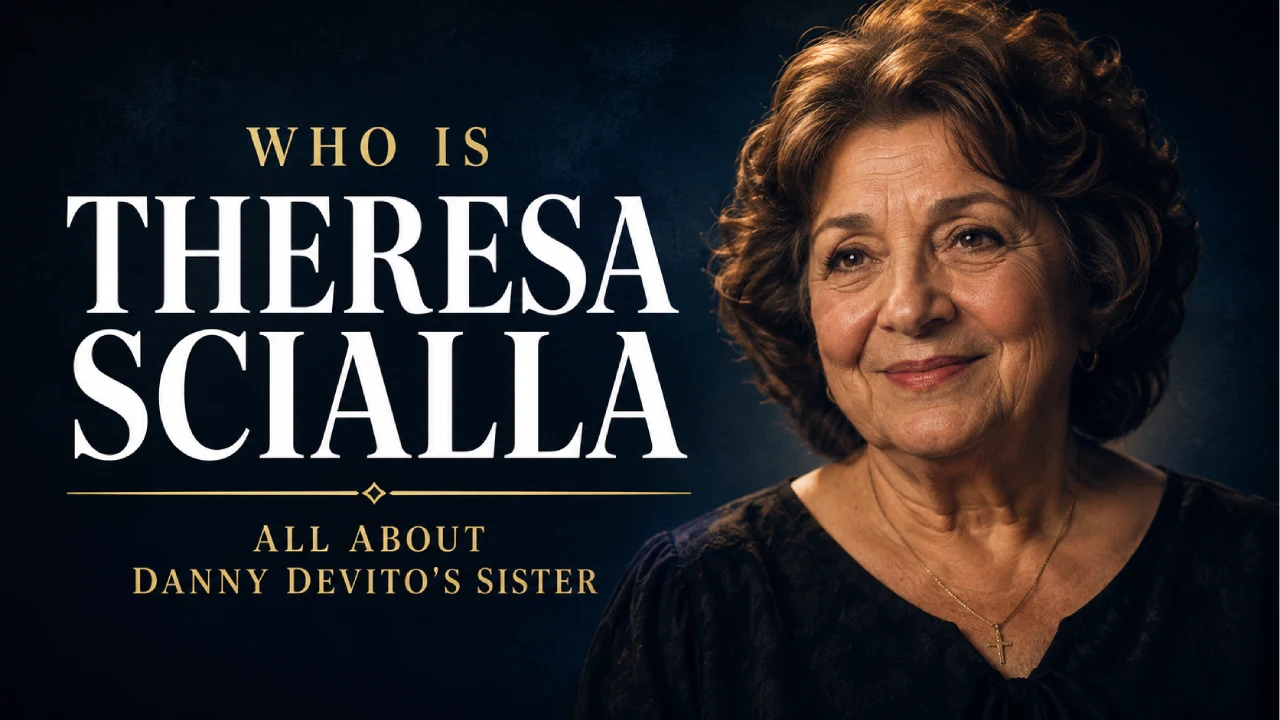
When people think of the DeVito name, they think of Danny DeVito — the actor, director, and producer whose career has spanned more than five decades, from Taxi and Twins to It’s Always Sunny in Philadelphia and beyond. But behind every public life is a private family, and behind Danny DeVito’s public life was a woman most people never knew: his sister, Theresa Scialla. This is her complete story — a life built on faith, family, and the quiet Italian-American values that shaped the DeVito household long before any camera ever pointed at it.
Theresa Scialla was a private individual — a daughter, a sister, a wife, a mother, and a grandmother — who lived her entire life away from the public attention that surrounded her famous brother. She never sought the spotlight. She gave no interviews. She made no public statements. She was, by every available measure, precisely what she chose to be: a quiet, faithful, family-centered woman whose world was measured in home and community rather than headlines.
Her name is known today primarily because of her brother. People who search for Danny DeVito’s family often discover her name — and then find very little about her beyond the basic biographical facts. This article assembles everything that is publicly available about her life, presented with the care and respect that a person who valued privacy deserves.
What emerges from those facts is a portrait of a woman whose life was not small because it was private. It was full — rich with the kind of meaning that comes from deep relationships, sustained faith, and a clear sense of what matters. In a culture that frequently confuses visibility with significance, Theresa Scialla’s life is a quiet but clear counterexample.
| Full Name | Theresa Scialla (née DeVito) |
| Birth Date | c. 1933–1934 (April 2, 1934 per public records) |
| Birthplace | Neptune / Asbury Park, New Jersey |
| Nationality | American |
| Ethnicity | Italian-American |
| Parents | Daniel Michael DeVito Sr. and Julia DeVito |
| Siblings | Angela DeVito, Danny DeVito |
| Religion | Roman Catholic |
| Marital Status | Married (surname Scialla) |
| Children | Yes — children and grandchildren |
| Date of Death | July 1, 2014 |
| Age at Death | 80 years old |
| Cause of Death | Not publicly disclosed |
| Net Worth | Less than $1 million |
Theresa DeVito — as she was known before her marriage — was born around 1933–1934 in New Jersey, most likely in the Neptune or Asbury Park area where the DeVito family was rooted. New Jersey’s Shore communities in that era were tightly knit, working-class, and heavily shaped by the Italian-American immigrant culture that had taken hold in the region across the previous generation.
The world Theresa was born into was one where the neighbourhood was an extension of the family — where everyone on the block knew your name, where Sunday dinners were long and loud, where the parish church organised the rhythm of the week, and where the values of the old country were maintained alongside the practical demands of building American lives.
Growing up in this environment gave Theresa a specific set of anchors: faith, family, community, and the steady daily rhythms of a home that valued warmth over ambition and connection over achievement. These were not small things. They were the foundations of a life — and Theresa carried them into every chapter that followed.
She was the older sister in a family of three children, which placed her in a specific role from the beginning: a witness to everything that came after her, a stabilising presence for her younger siblings, and ultimately a keeper of the family’s memory and shared history.
The DeVito household was run by Daniel Michael DeVito Sr. and his wife Julia DeVito. Daniel senior was an entrepreneur in the small-business sense — he ran a pool hall, a luncheonette, and a dry-cleaning business over the years, working hard to keep the family stable and comfortable without the benefit of inherited wealth or professional credentials.
Julia managed the home and raised the three children. In the Italian-American cultural tradition of that era, the home was the mother’s domain — and the values transmitted through that domestic space were as important as anything learned outside it. Julia’s influence on all three of her children would have been enormous, and in Theresa’s case that influence appears to have been absorbed most completely: she became the most domestically oriented of the siblings, the one who stayed closest to the pattern of family and faith that her mother modelled.
The household was Catholic in the way that Italian-American households of that generation typically were — meaning religion was not an abstract belief system but a lived practice woven into the texture of daily life. Mass on Sundays. Meatless Fridays. The rosary. The saints’ feast days. The rhythms of the liturgical calendar mapping onto the rhythms of the domestic one. These practices gave Theresa’s childhood a structure and a set of shared references that lasted her entire life.
Danny DeVito was born on November 17, 1944 — making him approximately a decade younger than Theresa, who was already a young teenager by the time her famous brother arrived. The age gap between them meant that their childhoods overlapped only partially, and that by the time Danny was forming his sharpest early memories, Theresa was already moving toward adulthood.
But the influence of an older sibling — particularly an older sister in an Italian-American household — is not measured purely in shared years. It is measured in the household tone, the family culture, the habits and values and stories that circulate through a home regardless of age differences. Theresa was part of the environment that shaped Danny long before he knew he wanted to perform.
Danny DeVito has spoken warmly about his family and his New Jersey roots throughout his career. He has consistently credited his upbringing as foundational to his worldview — the working-class sensibility, the warmth, the irreverence, the deep attachment to family that coexists in his public persona alongside the outrageousness of many of his performances. Theresa was part of what produced that foundation.
Their bond persisted into adulthood. When Theresa passed away in 2014, her obituary named Danny and his then-wife Rhea Perlman as part of her surviving family — a small but clear indication that despite the enormous divergence in their public lives, the sibling connection remained real and present until the end.
Theresa became Theresa Scialla through marriage — taking a surname that has Italian origins and is rooted in the same cultural tradition she grew up in. The details of her marriage — when it took place, who her husband was, how long they were together — have never been made publicly available, consistent with the complete privacy she maintained throughout her life.
What her obituary makes clear is that her marriage produced children and grandchildren — the two outcomes that, in the value system she was raised within, represented the deepest form of personal success. She built a family. She sustained it. She left people behind who loved her and who carry her forward.
Her husband’s name and circumstances are unknown publicly. This is not an oversight in the available record — it is a reflection of how thoroughly Theresa protected her private world. Even in death, the details of her marriage remained hers alone.
Faith was the organising principle of Theresa Scialla’s life in a way that is difficult to convey to people for whom religion is a more casual or compartmentalised experience. For someone raised in a devout Italian-American Catholic household in mid-century New Jersey, faith was not a choice made in adulthood — it was the air of childhood, absorbed before it could be evaluated, and carried forward into every subsequent stage of life.
Theresa remained a devoted Roman Catholic throughout her life. The church provided her with community, comfort, structure, and a framework for understanding the passages of life — birth, marriage, death, illness, grief — that required more than practical resources to navigate. Her faith was not performative. It was private and personal, expressed through the daily habits of a believer rather than any public profession.
Beyond faith, the texture of her daily life appears to have been built around the things she loved most: cooking for her family, caring for animals, spending time with her children and grandchildren, and maintaining the kind of home that people want to return to. These are not glamorous activities. They are the activities that make a life feel safe and warm to the people living within it — and that is precisely their value.
She was, by every indication, a woman who found joy in ordinary things. And the capacity to find joy in ordinary things is one of the more underrated forms of human wisdom.
The Italian-American cultural tradition that shaped Theresa Scialla’s life and her brother’s public persona has a connection to tattoo art that runs deeper and longer than most people realise — one that stretches from the working-class harbour communities of the early twentieth century all the way to the contemporary tattoo renaissance.
Italian-American communities in cities like New York, Boston, New Jersey, Philadelphia, and Chicago were among the earliest and most significant communities in American tattoo culture’s development. The sailors, dock workers, and servicemen from these communities were early adopters of tattoo art in the American context — bringing home imagery from military service and sea voyages and wearing it as markers of experience, identity, and belonging.
The imagery that characterised these early Italian-American tattoos was often deeply connected to Catholic faith — the Sacred Heart, the Virgin Mary, St. Christopher, guardian angels, and religious iconography that directly mirrored the devotional objects kept in homes like the DeVito household. A rosary tattooed on a forearm was not a contradiction of faith for an Italian-American Catholic of that era — it was an extension of it, a portable devotional object carried not in the pocket but in the skin.
This tradition feeds directly into the American Traditional and neo-traditional tattoo styles that remain among the most popular and widely practiced today. The bold outlines, limited colour palette, and iconic imagery of American Traditional tattooing are in significant part a legacy of the working-class Italian-American and other immigrant communities who shaped early tattoo culture in the northeastern United States.
Danny DeVito himself — the most public member of the family Theresa was born into — has become a beloved figure in tattoo culture in his own right. His face and characters have been tattooed on thousands of devoted fans worldwide, a testament to the specific kind of affection he generates. It is a form of tribute that would probably have bemused and amused Theresa enormously.
If you are considering a tattoo with Italian-American or Catholic iconographic roots — a Sacred Heart, a Madonna, a rosary, or any of the imagery that flows through that tradition — the aftercare process is exactly the same as for any other design. Our complete 2026 guide on what to use for tattoo aftercare covers the right products for every stage of healing. The day-by-day healing stages guide tells you exactly what to expect from day one through full recovery. If your tattoo is feeling dry or tight, our article on why a tattoo feels dry after moisturizing explains what is happening and how to address it. Everything is available in the TattooGleam aftercare library.
Theresa Scialla passed away on July 1, 2014, at the age of 80. Her cause of death was never disclosed publicly — a final act of privacy by a family that had always kept Theresa’s personal life carefully shielded from outside attention.
Her passing was not covered by entertainment media in the way that deaths connected to celebrities sometimes are. There were no tributes from Hollywood. There were no public memorials. Her obituary was quiet and personal — mentioning her children, her grandchildren, her surviving siblings including Danny, and the love that surrounded her life and her death.
That is exactly as she would have wanted it.
Her legacy lives in the people she raised and the values she transmitted. Her children carry her forward. Her grandchildren carry her forward. Danny DeVito, who grew up in the same household and absorbed the same foundation, carries something of her forward every time he credits his upbringing as the source of his most human qualities.
People still search for Theresa Scialla in 2026 because human curiosity about the people behind famous people is genuine and enduring. We want to understand the roots — the families, the households, the ordinary lives that produced extraordinary public figures. Theresa’s story answers a simple and honest question: who were the people who helped make Danny DeVito? She is one of them. And her life, lived quietly and well far from any camera, deserves to be told with care.
Who was Theresa Scialla?
Theresa Scialla, born Theresa DeVito, was the older sister of actor Danny DeVito. She was born around 1933–1934 in New Jersey into an Italian-American Catholic family and spent her life entirely outside public attention. She married and took the surname Scialla, had children and grandchildren, and was known for her deep faith, her love of family, and her completely private approach to life. She passed away on July 1, 2014, at the age of 80.
How old was Theresa Scialla when she died?
Theresa Scialla was 80 years old when she passed away on July 1, 2014. She was born around 1933–1934, with public records placing her birth date around April 2, 1934, though this has not been officially confirmed by her family.
What was Theresa Scialla’s cause of death?
Theresa Scialla’s cause of death was never publicly disclosed. Her family maintained complete privacy around the circumstances of her passing, consistent with the approach they took to her life throughout its entirety. No media coverage or public statement specified how she died.
Was Theresa Scialla related to Danny DeVito?
Yes. Theresa Scialla was Danny DeVito’s older sister. She was born Theresa DeVito and grew up with Danny and their sister Angela in an Italian-American household in New Jersey. Her obituary, published after her death in 2014, listed Danny DeVito and Rhea Perlman among her surviving family members, confirming the sibling connection.
What was Theresa Scialla’s net worth?
Theresa Scialla’s net worth is generally estimated at less than $1 million. She lived a modest, private life without any connection to the entertainment industry and did not seek or benefit from her famous brother’s wealth in any public way. Her financial life was entirely her own, built on her private circumstances rather than celebrity proximity.
Did Danny DeVito ever talk about his sister Theresa?
Danny DeVito has spoken warmly about his family and his New Jersey upbringing throughout his career, crediting his Italian-American background as foundational to his character. However, he has generally kept specific references to individual family members — including Theresa — private, consistent with the family’s overall approach to personal privacy. The mention of Danny and Rhea Perlman in Theresa’s 2014 obituary is one of the few public confirmations of their sibling connection.
Where was Theresa Scialla born?
Theresa Scialla was born in the Neptune and Asbury Park area of New Jersey — the same part of the state where the entire DeVito family was rooted. These were working-class Shore communities with strong Italian-American and Catholic cultural identities that shaped all three DeVito children in lasting ways.
Note: This article is a biographical piece for informational purposes only. All facts are drawn from publicly available sources including published obituary records. For tattoo aftercare guides and healing resources, visit tattoogleam.com.
TattooGleam Editorial Team
Tattoo aftercare experts · tattoogleam.com