September 4, 2026

In This Article
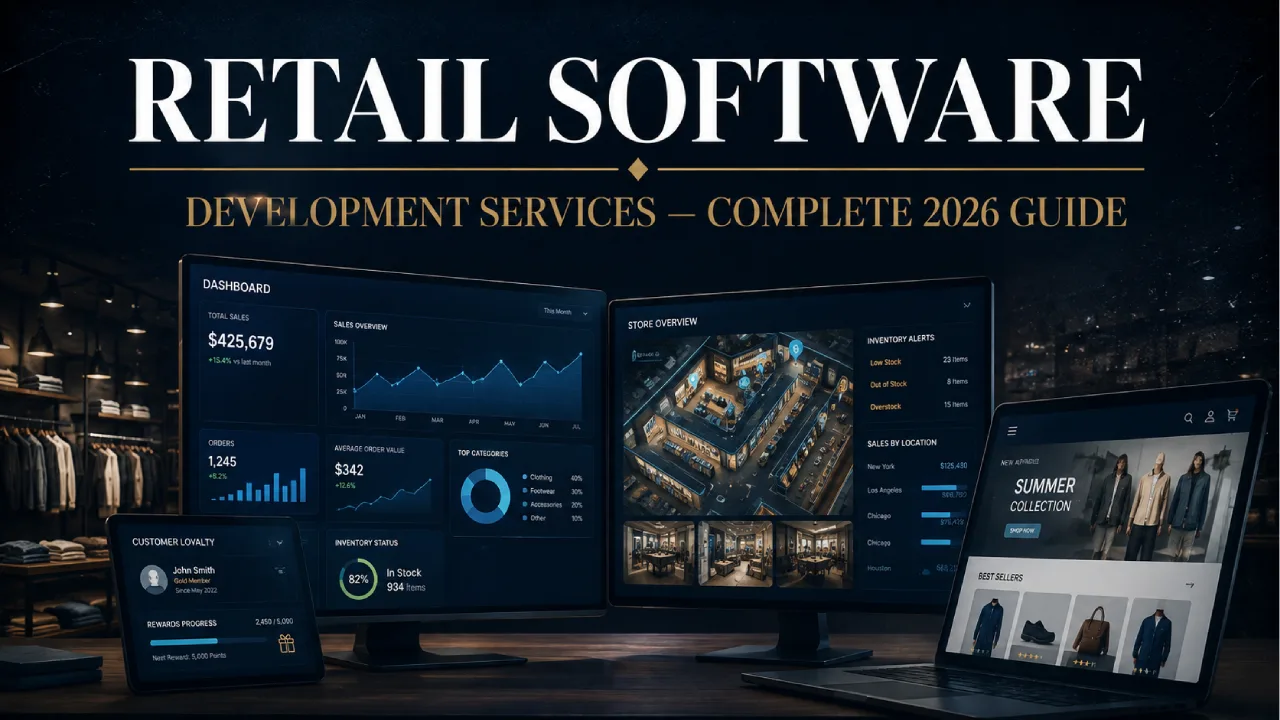
Retail software development services build custom digital tools that connect in-store and online shopping, manage stock, and improve customer experiences. If your current systems cannot sync inventory across your website and physical locations, your checkout experience is fragmented, your loyalty programme is disconnected from your CRM, or you are losing sales to manual processes that should be automated — this guide covers exactly what to do about it. We explain what retail software development services include, which providers are delivering the best work in 2026, what it costs, and how to evaluate your options before signing a contract.
Retail software development is the process of designing, building, and deploying custom digital systems that help retail businesses operate more efficiently and serve customers more effectively. Unlike off-the-shelf retail platforms such as Shopify, Salesforce Commerce Cloud, or Oracle Retail — which provide standardised functionality that every user shares — custom retail software is built specifically for a retailer’s unique operational needs, customer base, and competitive strategy.
The distinction matters significantly in practice. A standard Shopify store gives every retailer the same checkout flow, the same inventory management structure, and the same integration options. A custom-built omnichannel platform gives a specific retailer exactly the architecture their business requires — connecting their particular combination of physical stores, regional warehouses, wholesale channels, and digital touchpoints in a way that no off-the-shelf product can replicate.
Retail software development services typically cover the full project lifecycle: discovery and requirements gathering, system architecture design, front-end and back-end development, integration with existing ERP and POS systems, quality assurance testing, deployment, and ongoing maintenance. The agencies that provide these services operate at the intersection of retail strategy and technical execution — they need to understand both how retail businesses work and how to build software that serves those businesses well.
In 2026, the category has expanded significantly to include AI-powered features, real-time data synchronisation, and agentic commerce tools that automate customer interactions and inventory decisions without human intervention at each step.
Retail software development covers five major service categories. Understanding what each one does and when you need it is the foundation of a well-scoped project.
Custom POS development builds the registers and checkout interfaces that process payments, track local inventory, and save customer profiles at the transaction level. Unlike generic POS platforms such as Square, Lightspeed, or Clover, a custom POS is built to your specific workflow — integrating directly with your warehouse management system, your loyalty programme database, and your omnichannel inventory layer in real time. Custom POS development is particularly valuable for retailers with complex product configurations, multiple payment types, or high transaction volumes that generic platforms handle poorly.
Omnichannel development syncs online storefronts, mobile apps, and physical locations so stock counts match everywhere in real time. The specific technical challenge this solves is the inventory synchronisation problem: when a customer buys the last unit of a product in a physical store, that unit needs to disappear from the online store immediately — not in a batch update six hours later. Omnichannel platforms also enable cross-channel experiences like buy online pick up in store (BOPIS), ship from store, and unified customer profiles that track purchase history regardless of which channel the customer uses. In 2026, omnichannel integration is the single most common reason retailers commission custom software development.
Custom inventory and supply chain software automates warehouse tracking, reorder alerts, and supplier links. This category of development serves retailers who have outgrown spreadsheet-based inventory management or whose existing warehouse management system (WMS) cannot communicate effectively with their storefront, their suppliers, or their third-party logistics (3PL) partners. Effective supply chain software gives retailers visibility from purchase order to shelf — tracking goods through customs, through distribution centres, and into individual store locations with enough granularity to make real-time replenishment decisions.
Custom loyalty and CRM development creates reward programmes, personalized product suggestions, and targeted marketing campaigns connected directly to transaction data. Off-the-shelf CRM platforms like Salesforce, HubSpot, and Klaviyo work well for many retailers, but businesses with complex loyalty structures — tiered programmes, partner rewards, experiential benefits — or very large customer databases often need custom-built solutions that integrate purchase history, customer service interactions, and marketing engagement into a single unified profile. The data architecture that enables genuine personalisation at scale is typically a custom engineering project rather than a configuration task.
AI integration in retail software adds demand forecasting, smart chatbots, and dynamic pricing to existing or new platforms. Demand forecasting uses historical sales data, seasonality patterns, and external signals (weather, events, economic indicators) to predict what inventory will be needed before it runs low. Dynamic pricing adjusts prices in real time based on competitor pricing, demand signals, and margin targets. Smart chatbots handle customer service queries, product recommendations, and order tracking without requiring human agent intervention. These features are increasingly standard in custom retail platform builds in 2026 rather than premium add-ons.
Not every retail business needs a custom software development engagement. Understanding the specific situations that justify the investment helps retailers avoid over-engineering their operations and helps them recognise the signs that standard platforms have genuinely stopped serving them.
The following agencies represent the strongest options for retail software development in 2026, each with a different profile in terms of scale, specialisation, and approach. Matching the right agency to your specific project type is as important as evaluating technical quality in isolation.
G&CO. is a global strategy and experience partner combining retail consulting with full-stack software development for enterprise brands. Their work spans omnichannel strategy and integration, CRM and loyalty development, AI integration, and enterprise architecture — delivered for major fashion, luxury, and lifestyle retailers. G&CO. holds minority business enterprise (MBE) certification from the National Minority Supplier Development Council (NMSDC), which is relevant for organisations with diversity inclusion requirements in their supplier processes. Best suited for large-scale enterprise retail transformations where strategic consulting and technology implementation need to be tightly integrated.
Appinventiv builds unified order management systems and smart AI-powered search tools for large retail groups. Their development work focuses on connecting complex multi-channel order flows into a single management interface and building product discovery experiences that use machine learning to surface the right products for each customer. Particularly strong for retailers dealing with high SKU counts and complex order routing logic across multiple fulfilment locations.
Simform focuses on cloud-native application development and digital transformation for growing retail brands. Their work emphasises scalable architecture that starts at the right size for a growing business and expands cleanly as volume increases — avoiding the over-engineering problem that sometimes accompanies enterprise-scale builds for businesses that are not yet enterprise scale.
MobiDev specialises in AI-driven retail tools, IoT-based inventory tracking, and custom retail applications. Their IoT capability is particularly relevant for retailers using smart shelving, RFID-based stock tracking, or sensor-driven loss prevention systems that need to connect to a central software platform. Their AI work covers demand forecasting, customer behaviour analysis, and automated reordering systems.
WillowTree is a premier retail software development company known for delivering scalable custom retail software and store management applications. Their expertise spans retail supply chain software, retail execution software, and omnichannel solutions that unify physical and digital environments. They have partnered with major consumer brands to create data-driven, high-performance retail applications.
Thoughtworks specialises in retail software development services that drive digital-first transformation across the retail industry. Their emphasis on agile development and continuous delivery suits retailers who need to release improvements frequently rather than waiting for large monolithic releases. Strong for custom retail software, business management software, and supply chain tools that need to adapt quickly to market changes.
The agency selection process matters as much as the technical work that follows. A misaligned partnership produces poor outcomes even when both parties are capable — the right match requires alignment on industry experience, technical approach, communication style, and scale.
Retail software development pricing varies significantly based on project scope, complexity, customisation requirements, and the agency’s location and rate structure. Here is a realistic breakdown of what to expect in 2026:
| Project Type | Typical Cost Range | Timeline | What It Covers |
| Custom POS system (small retail) | $10K–$50K | 8–12 weeks | Payment processing, basic inventory, customer profiles |
| Inventory management tool | $20K–$80K | 10–16 weeks | Warehouse tracking, reorder alerts, supplier integration |
| Omnichannel platform (mid-market) | $80K–$250K | 16–24 weeks | Online + offline sync, mobile app, real-time inventory |
| CRM and loyalty platform | $50K–$200K | 12–20 weeks | Reward programmes, personalisation, campaign automation |
| Enterprise retail platform | $200K–$1M+ | 6–18 months | Full stack: POS, omnichannel, supply chain, AI, CRM |
| Ongoing support and maintenance | $3K–$20K/month | Ongoing | Bug fixes, updates, feature additions, security patches |
Key factors that increase cost: high degree of customisation, complex integration with multiple legacy systems, AI feature development, multi-location or multi-country deployment, and aggressive timeline requirements. Key factors that reduce cost: clear scope definition before development begins, using open-source frameworks where appropriate, phased delivery starting with core features, and selecting agencies in lower-cost locations for execution work while retaining strategic direction locally.
The technology stack your retail software runs on affects its performance, maintenance cost, integration capability, and long-term scalability. Here is a summary of the most common choices in 2026 and the considerations that should drive the decision:
| Layer | Common Choices in 2026 | Key Consideration |
| Frontend | React, Next.js, Vue.js | Performance on mobile is critical — 70%+ of retail traffic is mobile |
| Backend / API | Node.js, Python (Django/FastAPI), Java | API-first design enables future integrations without rewrites |
| Database | PostgreSQL, MongoDB, Redis | Real-time inventory needs low-latency cache layers (Redis) |
| Cloud Infrastructure | AWS, Google Cloud, Microsoft Azure | Auto-scaling is essential for peak trading periods (Black Friday) |
| AI / ML | TensorFlow, PyTorch, OpenAI API | Pre-built models accelerate time to value for demand forecasting |
| Integration / Middleware | REST APIs, GraphQL, Kafka, MuleSoft | Real-time sync between POS and e-commerce requires event-driven architecture |
The AI capabilities being integrated into retail software development in 2026 range from genuinely transformative to overhyped. Here is an honest assessment of what is delivering real value and what is still more promise than proof.
Machine learning-based demand forecasting consistently reduces overstock and stock-out costs in retail operations. Models trained on historical sales data, seasonality patterns, promotional calendars, and external signals (weather, local events) outperform manual buying decisions across most retail categories. This is the most mature and proven AI application in retail software — the ROI is well documented and the technology is reliable.
Recommendation engines using collaborative filtering and session-based models reliably increase average order value and conversion rates on e-commerce platforms. Amazon’s business case for recommendation technology is the most documented in retail history, and the underlying approaches are now accessible to any retailer with sufficient transaction history. The key requirement is data: recommendation models need meaningful purchase history to produce meaningful recommendations.
Large language model-based chatbots connected to order management systems handle “where is my order?” queries reliably and at scale, significantly reducing inbound customer service contact volume for post-purchase queries. The use case is narrow but the value is real — 20 to 40 percent of retail customer service contacts are post-purchase status queries that do not require human judgement.
Algorithmic dynamic pricing — adjusting prices in real time based on demand, competitor prices, and margin targets — works well in categories where customers accept price variability (travel, accommodation, digital goods). In categories where customers expect price consistency (grocery, apparel at standard retail price points), poorly governed dynamic pricing generates customer trust damage that outweighs the revenue optimisation benefit. Build robust price floor and ceiling rules into any dynamic pricing implementation.
Before committing budget and timeline to a retail software development agency, these questions help separate the capable from the credible-sounding:
The retail software development category has direct relevance to tattoo studios and body art businesses — particularly those operating at the scale of multi-location studios, product retail alongside services, or branded merchandise lines.
Tattoo studios that sell aftercare products, branded merchandise, or gift cards alongside their appointment-based services are operating a hybrid retail and service business. The operational challenges this creates — tracking product inventory alongside appointment availability, managing customer loyalty across both service and retail purchases, and presenting a unified experience to clients regardless of which touchpoint they use — are the exact problems that retail software development services address.
For studios at this scale, the most relevant retail software services are custom POS systems that handle both appointment bookings and product sales in one transaction, inventory management tools connected to an online storefront selling aftercare products, and CRM systems that build unified client profiles across services and retail purchases. Our guide to the best tattoo studio management software in 2026 covers the specific platforms built for studio operations, while the broader retail software development landscape covers the custom build options for studios that have outgrown standard platforms.
For clients preparing for a tattoo appointment rather than running a studio, the aftercare side of things is what matters most. Our complete 2026 guide on what to use for tattoo aftercare covers the right products for every stage of healing. The day-by-day healing stages guide tells you exactly what to expect through full recovery.
What are retail software development services?
Retail software development services build custom digital tools that connect in-store and online shopping, manage stock, and improve customer experiences. Core services include custom Point of Sale (POS) systems, omnichannel platforms that sync storefronts and physical locations in real time, inventory and supply chain tools that automate warehouse tracking and reorder alerts, customer loyalty and CRM systems, and AI features like demand forecasting and dynamic pricing. These services are provided by specialist agencies or development companies that design and build software tailored to a specific retailer’s operational needs.
How much does retail software development cost?
Retail software development costs range from approximately $10,000 for a focused custom tool to $1 million or more for a full enterprise platform. A custom POS system for a small retailer typically costs $10,000 to $50,000 and takes 8 to 12 weeks. A mid-market omnichannel platform costs $80,000 to $250,000 and takes 16 to 24 weeks. Full enterprise retail platform builds covering POS, omnichannel, supply chain, AI, and CRM cost $200,000 to $1 million and take six to eighteen months. Ongoing support and maintenance typically adds $3,000 to $20,000 per month.
What is the difference between custom retail software and off-the-shelf platforms?
Off-the-shelf retail platforms like Shopify, Salesforce Commerce Cloud, or Oracle Retail provide standardised functionality shared by all users. Custom retail software is built specifically for a retailer’s unique operational requirements — connecting their particular combination of channels, systems, and workflows in ways that standard platforms cannot accommodate. Custom development is justified when the gap between what a standard platform offers and what the business actually needs is structural rather than a configuration problem.
Who are the top retail software development companies in 2026?
The leading retail software development agencies in 2026 include G&CO. (enterprise retail strategy and technology), Appinventiv (unified order systems and AI search for large retail groups), Simform (cloud-native apps for growing brands), MobiDev (AI-driven tools and IoT inventory tracking), WillowTree (scalable omnichannel retail apps), and Thoughtworks (agile digital transformation). The right choice depends on your business size, project type, existing infrastructure, and whether you need strategic consulting alongside technical development.
How long does a retail software development project take?
Timelines vary by project scope and complexity. Smaller custom retail software projects or store management software upgrades typically complete in 8 to 12 weeks. Mid-market omnichannel platforms take 16 to 24 weeks. Large-scale supply chain software or full enterprise platform implementations take six months or longer. Key factors that extend timelines include high customisation requirements, complex integration with legacy systems, slow stakeholder decision-making, and extensive testing requirements.
What AI features are worth including in retail software in 2026?
The AI features with the clearest proven ROI in retail software are demand forecasting (reduces overstock and stock-out costs), personalised product recommendation engines (increases average order value), and AI-powered chatbots for post-purchase order tracking queries (reduces customer service contact volume). Dynamic pricing works well in certain categories but requires careful governance to avoid customer trust damage. AI-powered inventory optimisation and AI search are increasingly standard in new custom retail platform builds in 2026.
Do I need mobile apps or a web platform for my retail software project?
Most retail software projects in 2026 require both — a web platform for back-office management and an accessible mobile experience for customer-facing features. Over 70 percent of retail e-commerce traffic arrives through mobile devices, making mobile performance a baseline requirement rather than an enhancement. For staff-facing tools like POS and inventory management, tablet-optimised web applications often replace dedicated native apps, reducing development and maintenance costs without sacrificing functionality.
Note: This article is for informational purposes only. Pricing and service details vary by agency and project. Always verify current capabilities and pricing directly with any development partner before committing. For tattoo studio management software, aftercare guides, and healing resources, visit tattoogleam.com.
TattooGleam Editorial Team
Tattoo aftercare experts · tattoogleam.com